A small Japanese town turns hot springs and floor mats into 1.4M annual visitors. Korea hit 20M inbound tourists in 2024, but repeat rate tells a different story.
Eleven years ago, in the summer of 2015.
I'd just sold my second startup to Yello Mobile. Not long after, I boarded a plane to Fukuoka with my family — my mother and younger sister. It was a long-overdue trip I'd postponed for years under the excuse of "running a startup," equal parts guilt offering and personal reset.
My mother isn't big on sightseeing, but she loves Japanese food. She prefers rest over rush. So I picked a ryokan. Fukuoka's a short flight (she gets carsick), and Yufuin felt like the right call. It wasn't cheap, but it was our first family trip since my father passed. I went all in and booked through an agency.
At Fukuoka Airport, a tour guide held up a sign with my name in Korean. The minibus he led us to looked older than the guide himself — the kind of van you'd take to a mountain lodge in Taebaek. We rattled along winding roads for over an hour, the scenery thinning out as we climbed. At the end, we arrived at a traditional ryokan. The building was old but well-kept. Staff in kimonos greeted us with the cheerful, almost theatrical hospitality the Japanese do so well. We sipped green tea, I looked after my mother, who'd gotten carsick, and before I knew it we were being led down corridors to our room.
A tatami room. With futons you roll out yourself. Damn.
I'd tried to plan a proper trip for my mom, paid decent money — and I'd somehow landed us in a place where we'd be sleeping on floor mats. My mother, who can't sleep unless she's in a real bed. I kicked myself for not double-checking.
Bumpy transport, underwhelming facilities, and now this DIY bedding setup. By then, I couldn't figure out why we'd paid so much. Stranger still: the place was nearly booked out. Apparently, plenty of people thought this was worth the price.
But over the two days we stayed, something shifted.
The property was layered with signage in multiple languages. Staff anticipated needs before we voiced them. But the standout was kaiseki — traditional multi-course Japanese dining, served directly in our room. A nakai (room attendant) brought dishes one by one. At some point, while we ate, she'd slipped in and rolled out our futons. My mother, who'd been pale from the drive, looked visibly lighter after that. And it wasn't just the centuries-old hot spring water.
Ordinary Things, Extraordinary Products
Yufuin is a town of 30,000 people.
That town, part of Yufu City, received 1.44 million foreign tourists in 2024 alone. A record high — up 40% year-over-year (Nikkei, 2025). Shirakawa-go is a mountain village of 500 residents. In 2024, it saw 2.08 million visitors — half of them, 1.11 million, were foreigners (Gifu Prefecture Shirakawa Village Tourism Statistics). These places don't have overwhelming natural advantages. Yufuin's hot springs aren't dramatically better than Gangwon-do or Chungnam's. Shirakawa-go's gassho houses aren't grander than Hahoe Village or Naganeupseong Folk Village.
Yet they became products. Why? Because they told stories about why you should come. And they made those stories accessible — with guides, facilities, and details designed for foreign visitors.
France didn't become a 100-million-tourist-a-year destination overnight.
Korea is expecting a record 22 million tourists in 2026 (Korea Culture and Tourism Institute). France hit 100 million in 2024 (€71 billion in tourism revenue). Spain logged 93.8 million (up 10.1% YoY).
Countries that crossed into tourism powerhouse status ahead of us have been refining their narratives for decades — some for over a century.
Not Kaiseki. Korean Food.
Korea is becoming a cultural superpower.
What started with K-pop and K-drama has expanded beyond content into the pillars of daily life — fashion, food, language. The rise of Korean language courses and Korean restaurants globally tells the story in numbers alone.
Korean food, in particular, is having a moment.
This curiosity runs deep: 64% of inbound tourists cite Korean food as a reason for visiting. Once they try it, satisfaction hits 94.2%, and intent to eat it again crosses 80.6% — the first time it's broken 80% (2025 Korean Food Overseas Consumer Survey, 11,000 respondents across 22 cities, Korea Agro-Fisheries & Food Trade Corp. and Ministry of Agriculture). Korean food is clearly a pillar of Korea's tourism boom.
But right now, Korean food exists in tourism as scattered one-off experiences.
Buldak ramyeon at the convenience store. Chimaek at an old Euljiro joint. Yangnyeom galbi in Cheongdam-dong. They're all there — but they don't connect.
What if we stitched them into a story? Imagine boarding a fishing boat off the coast of Sokcho, Gangwon-do, catching flatfish, and having it sliced into hoe right there on the deck. Or visiting a rice mill in Yangpyeong, cutting fresh garaetteok, and cooking tteokbokki on the spot.
Or this: you fly into Incheon, drive two hours to Gapyeong. Or land at Gimhae, drive two hours to Namhae. You check into a pension. And that night — not quite kaiseki, but not far off — you're served a multi-course Korean meal, curated, plated, and presented as a story. If that experience is tied to your stay, wouldn't paying ₩200,000+ a night feel worth it?
Just like the ryokan in Yufuin wasn't selling a room. It was selling a layered experience — lodging, dining, hot springs — woven into a narrative.
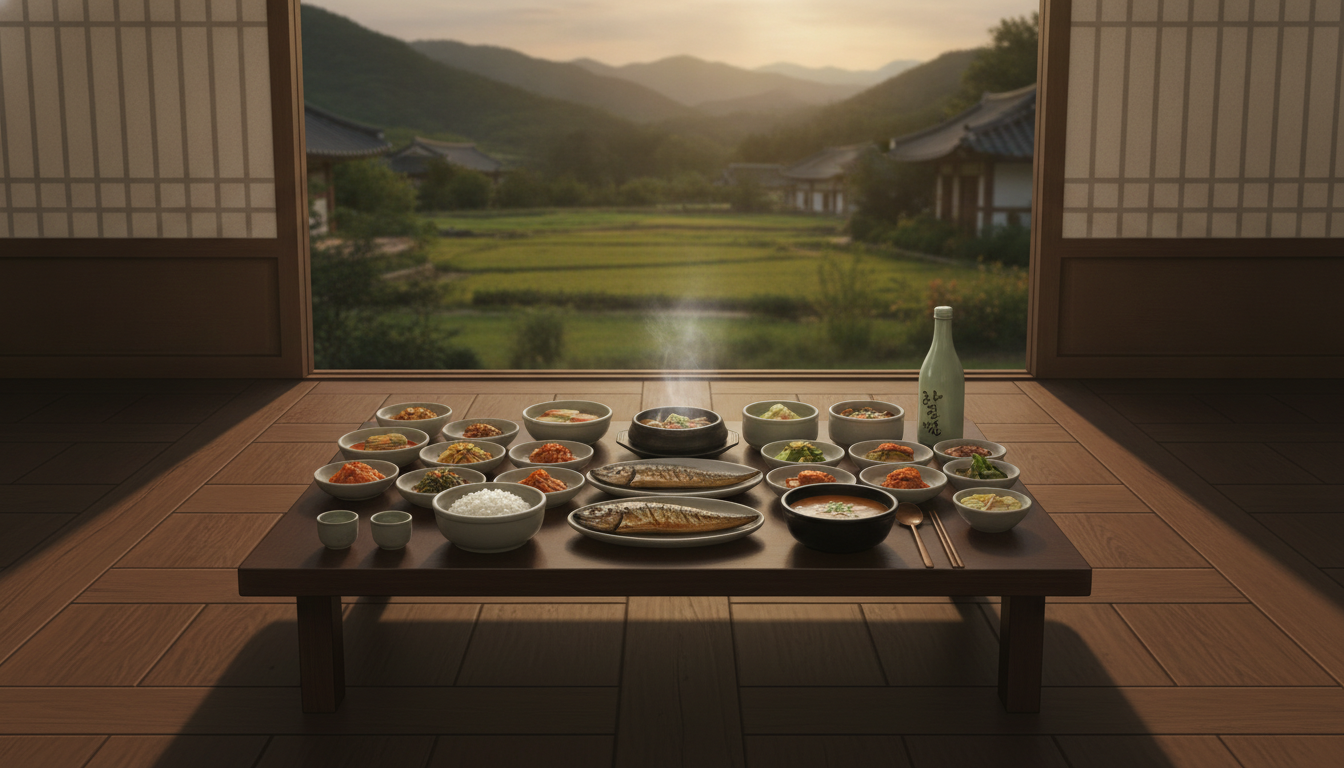
What we're missing isn't content. It's curation — the ability to bundle these elements into a coherent, elevated story. And then to make that story legible to global travelers by adding English menus, multilingual signage, and seamless service design.
Korean hospitality is already world-class. AI translation tools make language barriers trivial. The infrastructure is here. The question is whether we'll use it.
A One-Time Visit Country
Korea received 18.93 million foreign tourists in 2025. A record high, up 15.7% YoY (Korea Tourism Organization, 2026). Japan, in the same year, received 42.68 million and recorded ¥9.5 trillion in tourism spending.
But the gap that concerns me more than volume is repeat visitation. Korea's repeat visitor rate dropped from 58.3% in 2019 to 54.7% in 2024 (KCTI 2024 Inbound Tourist Survey). More people are coming. Fewer are returning. And 77.3% of visitors still stay only in Seoul.
We all know why. Korea intrigues them — K-pop, K-dramas, the food they've seen on screen. But once they arrive, the experience doesn't match the maturity of Japan or France.
In a country that translates yukoe (Korean beef tartare) as "Six times," versus one that brings kaiseki into your room, which would you visit twice?
I wrote recently about how stopping scams requires systemic change. The sustainability of Korean tourism hinges on the same principle. If we treat foreign visitors who flew thousands of miles as one-time customers — squeezing short-term profit, inflating prices — their curiosity will cool fast.
To Become a Country People Come Back To
This is just the beginning.
We don't know how long the K-content wave will last. But given that interest has expanded from media into food and culture, it's unlikely to fade soon. The global Hallyu fanbase has reached 225 million across 119 countries, and 38.3% of inbound tourists cite K-content as a reason for visiting (Ministry of Foreign Affairs 2023 Global Hallyu Status Report; KCTI 2024 Inbound Tourist Survey).
Incheon Airport to Yangpyeong or Gapyeong: two hours. To Gangneung by KTX: two hours. Add Gimhae International and Yangyang International to the equation, and suddenly dozens of regional cities become accessible to foreign tourists.
For an American used to long drives, these are practically next door. We can offer an experience worth ₩300,000–500,000 a night — if we embed culture into that stay.
To do that, every region needs a story that explains why it's worth the trip.
Signage, menus, apps, and maps should be fluent in at least three languages. Guests shouldn't struggle to order BBQ because the restaurant doesn't take cards. You don't have to serve food in-room like kaiseki, but lodging and dining should be close enough that renting a car isn't mandatory.
Local restaurants and accommodations should become each other's products. Breakfast and dinner should be bundled with the room rate.
We have Korean food — a cuisine that works anywhere in the world. When you layer it onto a night in Korea, the country from K-dramas, lodging stops being real estate rental and becomes a cultural product. That's how you give people a reason to return.
Ryokans don't sell rooms and hot springs. They sell a day's journey. A story. An experience. A night in a Korean pension, wrapped in Korean food and regional narrative, can be just as compelling.
Research shows that 41.7 tourists equal the consumption of one permanent resident (Korea Culture and Tourism Institute, 2022). Korea re-designated 89 population-decline regions in 2026 (Ministry of the Interior and Safety, 2026). Tourism is how those regions survive.
At ONDA, we're helping our lodging clients prepare for foreign guests. We're translating their websites (booking engines), integrating international payment gateways, and optimizing for AI assistants like ChatGPT and Gemini so they surface in recommendations.
Some of our faster-moving clients are already pushing us to move quicker. But a multilingual website alone won't be enough if the experience itself isn't ready. The good news: there's still time to prepare.
18.93 million annual visitors may not be the peak. It could be the floor.
I want Korea's regions to thrive. I want visitors to come back. Not because we beat Japan — but because we became a country worth returning to. We can do this. And our lodging operators are the ones who will make it happen.
⚠️ All rights reserved. Cite this piece as 'ONDA (온다)' when quoting.