Where should I list my property to maximize bookings?
Here's how to solve your revenue puzzle.
Hi — ONDA here. Today we're sharing practical tips for property owners and operators who've kept going through COVID-19 — staying on top of cleaning protocols and guest safety.
You've probably been thinking hard about sales and revenue, especially now. How do we keep rooms full? Which channels actually work?
That's exactly what we're covering today: where to list your property, and how to manage it all without losing your mind.
How are you selling your rooms right now?
Most hoteliers already know about the major Korean booking platforms. Many of you are already live on a few. But here's what's tricky: which channels suit your property type? Which ones convert best? And what are you missing?
Let's break down the major domestic distribution channels so you can make informed decisions.
A taxonomy of accommodation sales channels
Online distribution is vast and confusing. So ONDA has categorized the key channels by type. Here's what you need to know.
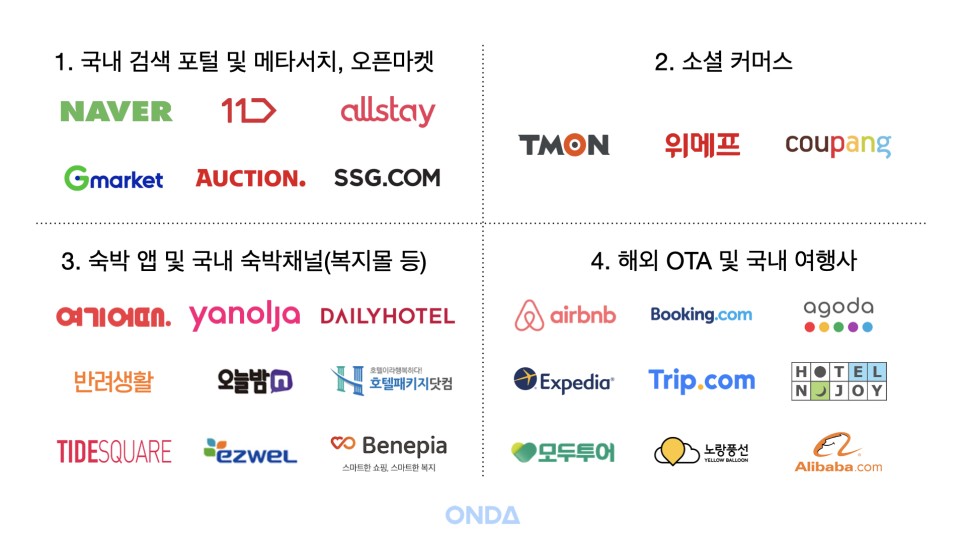
1. Search portals, metasearch, and open marketplaces
Start with the obvious: Google, Daum.
You probably found this post through one of them. Google dominates globally, and its influence is massive. When people plan trips, their first move is to search — "hotels near Busan," "guesthouses in Gangneung," etc.
Google knows this, and offers metasearch and booking via Google Hotels and Google Lodging. It's mostly used for international travel from Korea (outbound), but once it scales domestically, expect seismic impact.
Metasearch and open marketplaces work similarly. 11st is Korea's top accommodation metasearch — it aggregates prices across platforms so users can compare instantly. Gmarket and Auction (both open marketplaces) let you sell rooms alongside attraction tickets, creating bundled deals or promotions. Not accommodation-first platforms, but high traffic and card/coupon promotions make them worth exploring.
If you haven't listed on 11st, Gmarket, or Auction yet — now's the time.
2. Social commerce platforms
Korea's big three: TMON, WeMakePrice, Coupang.
Social commerce platforms spread via social networks and emphasize steep discounts. Unlike traditional e-commerce, they lean into viral sharing, flash deals, and high-volume turnover. Reviews pile up fast. Young travelers love them.
These platforms sell everything — so your accommodation listing sits next to skincare and sneakers. That's actually good: cross-category browsing drives spontaneous bookings. Someone shopping for a jacket might end up booking a pension.
Recently, all three have ramped up travel/lodging categories with curated sales and promotions. Great for package deals and flash discounts — especially if you're targeting deal hunters and younger demographics.
3. Accommodation apps, domestic OTAs, and corporate benefit malls
Accommodation apps have reshaped Korea's lodging landscape. Yanolja and Yeogi Eottae lead the pack. Once associated mainly with motels, both have aggressively expanded into pensions, guesthouses, and hotels. Mobile-first design makes search, comparison, and booking frictionless — especially for last-minute or local getaways.
Other players include Dailyhotel, HotelPackages.com, Oneulbamen, and Petlife (pet-friendly lodging). These platforms target accommodation exclusively, so traffic is highly qualified.
Don't sleep on corporate benefit malls like EZwel, EGenU, and SK Benepia. These serve enterprise customers — employees spending company welfare points. Conversion is high because users already have allocated budgets. Plus, they're ideal for group bookings and seminar packages. If your property caters to business travelers or corporate events, these channels are goldmines.
Note: Korea Tourism Organization's Worker Vacation Support Program distributes ₩400,000 in travel credits — usable only on SK Benepia. That's guaranteed demand.
4. Domestic travel agencies
Traditional Korean travel agencies — Hanatour, Modetour — once focused on package tours for older demographics. As independent travel surged, they pivoted to offer à la carte bookings: flights, activities, lodging. Their strength? Group and package bookings. If you run a hotel or hostel with meeting facilities, these agencies can fill dozens of rooms at once.
So… which channels should you use?
Here's the thing: it depends entirely on your property.
Ask yourself:
- Location: Seoul or regional? Near a tourist hotspot?
- Property type: Guesthouse, hotel, pension, motel?
- Target guest: Domestic or international? Students, families, business travelers?
- Booking behavior: Spontaneous or planned? Price-sensitive or premium?
Examples:
- Motel targeting young Korean couples → Yanolja, Yeogi Eottae (mobile-first, high conversion)
- Pension for family weekends → TMON, WeMakePrice (package deals, reviews)
- Business hotel near convention center → Corporate benefit malls, Hanatour
Still unsure?
ONDA's hospitality consultants offer free channel strategy sessions — and we can manage distribution for you.
If choosing one channel feels limiting — or managing multiple channels manually feels overwhelming — consider ONDA's distribution service. We'll connect your property to all major channels and handle the heavy lifting. More on that next time. 😉
To recap:
We've mapped out the major online sales channels for Korean accommodations.
Want to list on multiple platforms with a single integration?
>> Contact ONDA <<
Thanks for reading.
We'll be back with more actionable insights soon. :)
Shaping a better tomorrow for hospitality.
ONDA — Integrated Booking Management for Accommodations
⚠️ All rights reserved. Cite this piece as 'ONDA' when quoting.