
Hi there — welcome to Weekly ON, your hospitality newsletter. Have you tried Korea's Hotel Sale Festa yet? I used it for a domestic trip last year. What started as an economic stimulus program has become the lodging industry's signature annual event. So how did 2023 perform?
⚠️ All rights reserved. Cite this piece as 'ONDA' when quoting.
In today's issue
🏠 Hotel discount program results and regional trends
⌨️ #JuneTravelMonth #GlobalChainExpansion #NonTravelPlatforms #EcoFriendlyPush #JejuForeignTourists
🏨 Industry Spotlight
Hotel discount program results and regional trends
Since 2020, Korea's government-backed hotel discount program has run annually to boost domestic tourism and consumer spending. Last year it rebranded as the "Korea Hotel Sale Festa."
The program has become the lodging industry's biggest yearly event. So what did the data show? And what patterns emerged across regions and property types?
2023 Hotel discount program performance
Across three rounds — spring (May–June), Chuseok holiday (Sept–Oct), and fall (Oct–Nov) — 1.303 million coupons were redeemed in 2023's Hotel Sale Festa.
Those bookings generated roughly 3.11 million domestic trips. The program drove ₩180.8 billion in accommodation spending and ₩522.6 billion in total travel expenditure.
Coupon use: Hotels and motels 80%, pensions and resorts 20%
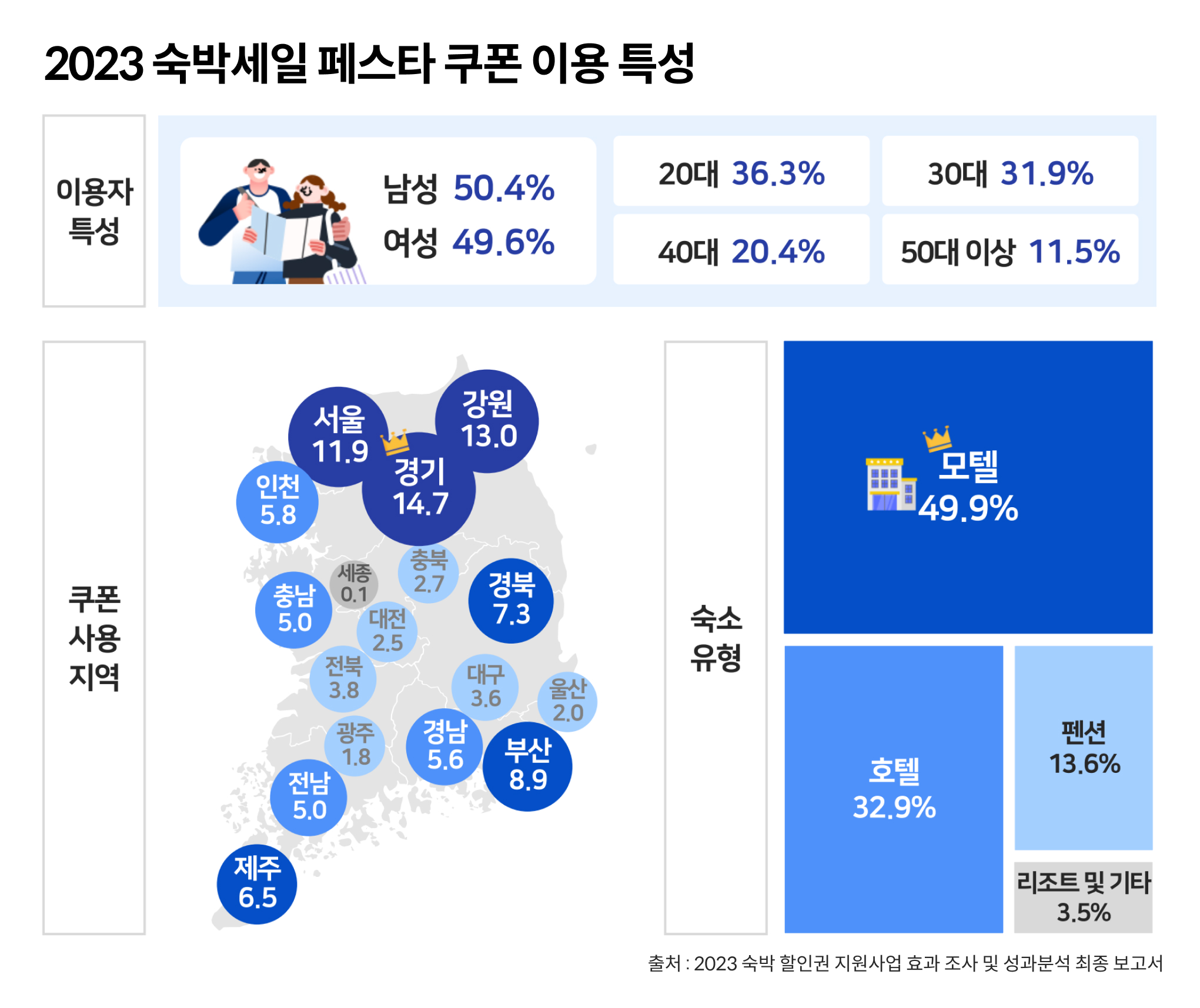
Younger travelers booked more aggressively. Gen Z and Millennials (ages 20–39) accounted for roughly 70% of all coupon redemptions. However, average room rates booked by travelers in their 30s and 40s — who often travel with young children — were significantly higher.
The most popular property types were motels (49.9%) and hotels (32.9%). Eight out of 10 coupons went to hotels or motels.
Pensions (13.6%) and resorts/other (3.5%) had lower shares — but in absolute terms, pensions and resorts still generated around 220,000 bookings through the program alone.
Also worth noting: motels are heavily concentrated in the Seoul metro area. Preferred property types vary significantly by region — so national averages don't tell the full story.
Let's zoom in on regional trends.
👉<2023 Hotel Sale Festa Data Roundup>
⌨️ Keyword News
TL;DR: June Travel Month distributes 250,000 hotel coupons
The story: This June, Korea's Travel Month campaign returns. Like the March edition, it offers discounts on rail, flights, attractions, activities, and accommodation.
Lodging angle? 250,000 hotel discount coupons will be issued throughout June — valid only at properties outside the Seoul metro area (Seoul, Gyeonggi, Incheon excluded) to boost regional tourism.
TL;DR: Global luxury chains planning new Korean hotels
The story: Korea is becoming a battleground for international hotel brands. Marriott, Aman, Rosewood, and other global chains are accelerating Korean expansion.
Why? Korea's hotel industry underwent massive restructuring during the THAAD standoff and COVID years. Now that inbound tourism is recovering, supply shortages loom. Seoul has fewer luxury hotels than most major global cities — a gap foreign brands see as opportunity.
TL;DR: Non-travel platforms' hotel GMV keeps climbing
The story: Mobility apps, closed membership malls, portals, and e-commerce platforms are moving deeper into hotel bookings. Q1 2024 hotel GMV from non-travel platforms rose 38.13% YoY vs. 2023 and 112.59% vs. 2022.
Why? Hotel inventory helps platforms lock in users and capture product + customer data. Expect more non-travel players to keep entering the space.
TL;DR: Korean hotels rolling out eco-friendly services and packages
The story: Korea's hotel industry is joining the sustainability wave — launching green services and packages to support guests' value-driven consumption.
Examples? Beyond swapping toiletries, hotels are adopting eco-friendly uniforms and creating guest experiences that let travelers participate directly in environmental initiatives. Each property is finding its own angle.
TL;DR: Jeju foreign arrivals surge, but spending per visitor drops
The story: Q1 2024 saw roughly 360,000 foreign tourists visit Jeju — 6x the prior year — yet average monthly spending per visitor fell YoY.
Why? Cruise passengers, who spend less time on the island and often don't book hotels, now make up a larger share. Cruise tourists accounted for 32% of Q1 foreign arrivals to Jeju — more than double last year's proportion.