Weekly ON Vol.170
September 29, 2026
Today's Weekly ON
🏨 How to Understand the Hotel Business 💡 Local Government "Half-Price Travel" Programs Emerge as a New Demand-Creation Channel for the Accommodation Industry
⌨️ #Hotel #Marketing #Revenue
🏠 Industry Story
How to Understand the Hotel Business
A room you fail to sell today cannot be sold twice tomorrow. Hotel inventory expires at midnight every night.
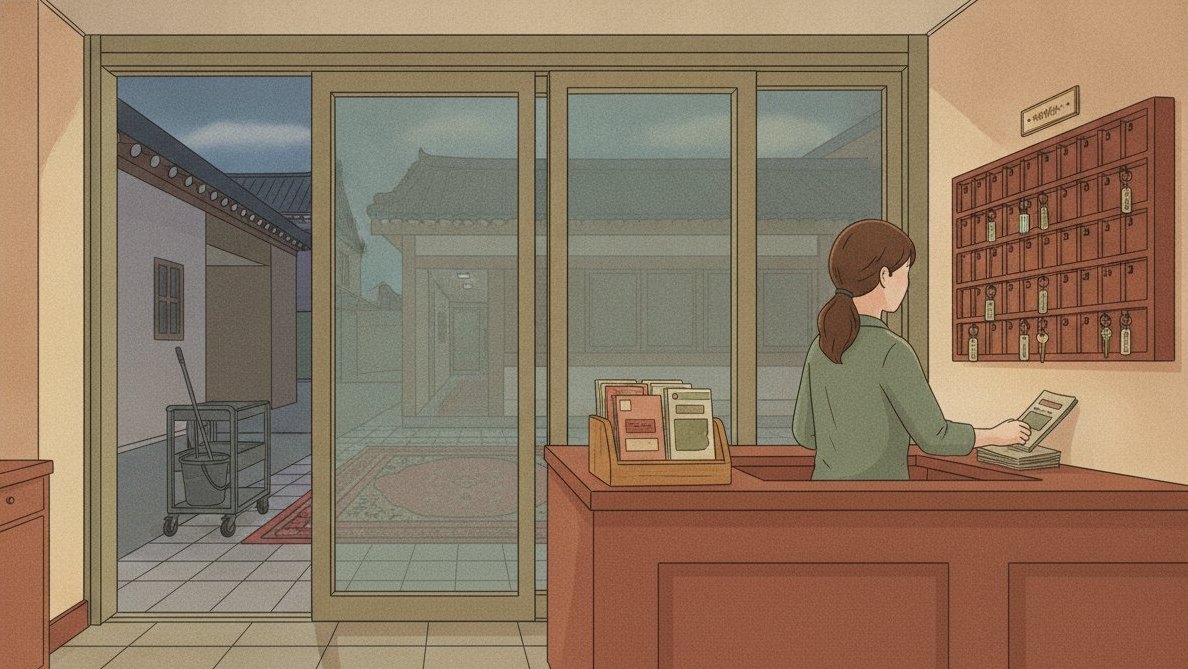
Yet many operators enter the business thinking of a hotel as nothing more than a "service business." One operator who spent eleven years on the front line sees it differently. Having weathered MERS, the THAAD dispute, and COVID-19 within the same building, his conclusion is this: a hotel is simultaneously a service business, a real estate business, and a sales business — a complex enterprise in which architecture, fire safety, hygiene, food and beverage, human resources, and marketing all operate in the same place at the same time. View it through any single lens and you will inevitably miss something.
In practice, there are properties whose location is strong for business demand yet whose rooms are configured for families, and properties with excellent facilities yet chronically high staff turnover. The problem, in other words, originates not in any particular department but in a structural mismatch within the business itself. What if there were a way to identify that mismatch before it takes hold?
Three perspectives for reading a hotel properly, and the true meaning of performance that only becomes visible when operating profit and asset returns are separated — where the answer begins may be more surprising than you expect.
💡 Hospitality Trends
Local Government "Half-Price Travel" Programs Emerge as a New Demand-Creation Channel for the Accommodation Industry
Local governments grappling with the threat of regional depopulation are rolling out bold travel-cost rebate programs to attract visitors. Yeonggwang County in South Jeolla Province has become a leading example with its "Half-Price Travel" initiative, which refunds 50–70% of what out-of-town tourists spend on accommodation, dining, and experiences within the county in the form of mobile local gift vouchers. The program is drawing attention not merely as a tourism subsidy but as a stay-based tourism strategy designed to create a virtuous cycle of visit → stay → spend → return visit. Accommodation operators should examine whether their properties can be included in this kind of local government support ecosystem.
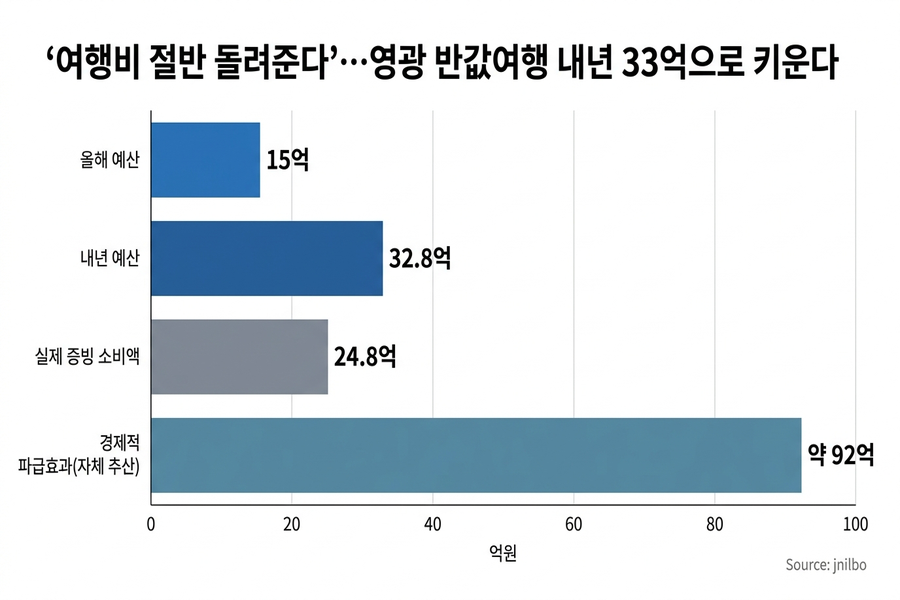
Key Data
Yeonggwang County plans to more than double its Half-Price Travel program next year, scaling the budget from KRW 1.5 billion this year to KRW 3.28 billion. Funding will be drawn from KRW 1.08 billion in grants from the government's regional vacation support program and KRW 2.2 billion from the regional depopulation response fund.
This year's results are also noteworthy. From the program's launch in April through early September — roughly five months — 26,389 people applied, and the verified spending by tourists within Yeonggwang County reached KRW 2.48 billion. Applying the Bank of Korea's input-output table coefficients, Yeonggwang County estimates the program's total economic ripple effect at approximately KRW 9.2 billion, comprising a production-inducement effect of KRW 6.26 billion, a value-added-inducement effect of KRW 2.94 billion, and a consumption-inducement effect of KRW 7.72 billion. In other words, the program generated approximately 2.1 times the direct subsidy amount in tourism consumption. Visitor numbers at tourist sites also rose 34.1% year-on-year in the first half of 2026, and sales on Yeonggwang Mall, the county's online shopping platform, roughly doubled compared to the same period last year. It should be noted, however, that the economic ripple-effect figures are the county's own estimates and should be interpreted separately from the net incremental spending figure.
Market Implications
The core implication of this program for the accommodation industry is "publicly created demand." From a tourist's perspective, having more than half of travel costs refunded significantly lowers the barrier to visiting. The program is demonstrably generating real accommodation demand in smaller non-capital-region cities that previously struggled to attract visitors.
The policy shift planned for next year also deserves attention. Yeonggwang County has announced it will move its focus from "how many visitors come" to "how long they stay." This means the county intends to concentrate on building overnight-stay demand — guests who stay one night or more — rather than day-trippers. Plans to expand weekday and off-peak promotions are also included, which could present accommodation operators with an opportunity to improve off-peak occupancy rates.
Furthermore, the Yeonggwang County model is likely to spread nationwide. The regional depopulation response fund is being distributed to 89 local governments across Korea, and a growing number of local authorities are adopting or considering similar travel-cost rebate models. A comparable program may already be in operation — or may soon be introduced — in the area where your property is located.
Recommended Actions
First, check immediately what tourism support programs your local government currently offers. Contact the tourism division of your city or county office, or monitor Korea's Ministry of Culture, Sports and Tourism's regional tourism support announcements, to determine whether you are eligible to participate in any travel rebate programs. Registering as a participating establishment gives you access to public marketing benefits at no cost.
Second, ensuring your property can accept mobile local gift voucher payments is essential. In programs structured like Yeonggwang's — where rebates are issued as mobile vouchers — properties that cannot accept that payment method are excluded from the resulting re-spending demand. If you have not yet registered as a local currency merchant, we strongly recommend doing so promptly.
Third, consider developing accommodation packages that extend guests' length of stay. The more strongly local governments emphasize stay-based tourism, the greater the advantage for properties that offer packages linking accommodation with nearby experiences, restaurants, and attractions — both in platform visibility and booking priority.
Source: Jeonnam Ilbo
⌨️ Keyword News
1️⃣ Tripbtoz Joins Accommodation Sale Festa — Discounts of Up to KRW 120,000
Summary: Tripbtoz is participating in the "2026 Korea Accommodation Sale Festa (Second Half Edition)" from September 22 to November 8, offering discounts of up to KRW 120,000 on non-capital-region accommodation products.
Details: The event is hosted by Korea's Ministry of Culture, Sports and Tourism and the Korea Tourism Organization, and covers licensed accommodation facilities in all non-capital regions except Sejong and North Chungcheong Province. Government discount coupons range from KRW 20,000 to KRW 70,000 depending on the booking amount; combined with Tripbtoz's own promotional code (7% of the payment amount, up to KRW 30,000) and affiliated payment method discounts (up to KRW 20,000), guests can save up to KRW 120,000 in total. A total of 13 OTAs, including Tripbtoz, are participating, and approximately 77,000 coupons will be issued on a first-come, first-served basis. Operators running non-capital-region properties should actively leverage increased Tripbtoz exposure and themed campaign tie-ins during this period to boost booking conversion rates.
👉Tripbtoz Joins Accommodation Sale Festa — Discounts of Up to KRW 120,000
2️⃣ Hotels Pioneer New Revenue Streams with K-Food — Kimchi, Seaweed, and Salt Accelerate Overseas Expansion
Summary: Korean hotel groups including Walkerhill and Lotte Hotel are advancing into overseas markets under their own food brands.
Details: Walkerhill Hotels & Resorts' cumulative overseas kimchi exports reached approximately 82 tonnes as of August this year — expanding into markets including the United States and Australia within just one year of its first export. Lotte Hotels & Resorts this month launched its own branded seaweed and salt products, introducing the hotel industry's first private-brand salt offering. The strategy combines the premium image of hotel brands with accumulated food and beverage expertise to convert the K-food boom into a new revenue stream. For accommodation operators, this is a timely moment to reconsider food and beverage services not merely as ancillary amenities but as independent revenue channels. Developing private-brand products tied to local specialty ingredients is also worth noting as a differentiation strategy.
3️⃣ Save Up to KRW 70,000 on Autumn Accommodation in Gangwon Province
Summary: Korea's Ministry of Culture, Sports and Tourism, the Korea Tourism Organization, and Gangwon Special Self-Governing Province are running the "2026 Korea Accommodation Sale Festa — Autumn Edition" from September 22 to November 8, with discounts of up to KRW 70,000 on accommodation bookings in the Gangwon region.
Details: Accommodation products priced at KRW 70,000 or more per night receive a KRW 30,000 discount; those priced below KRW 70,000 receive KRW 20,000 off. For bookings of two or more consecutive nights, products totalling KRW 140,000 or more qualify for discounts of up to KRW 70,000, making this a favorable period for multi-night stay strategies. Recommended destinations are Chuncheon and Sokcho in September, and Cheorwon and Inje in October, with travel demand expected to be distributed across these areas. A "Gangwon Tourism Bingo Challenge" running concurrently during the Chuseok holiday period is expected to drive additional visitor inflows. Properties in the Gangwon region should confirm their participation in the event and actively structure multi-night packages to improve booking conversion rates.
👉Save Up to KRW 70,000 on Autumn Accommodation in Gangwon Province
4️⃣ 2026 Michelin Guide Hotel Selection Unveiled — 2,832 Properties Selected Worldwide
Summary: The Michelin Guide has released its 2026 Hotel Selection. A total of 2,832 hotels worldwide received Michelin Keys, with nine hotels in Korea included.
Details: Michelin Guide inspectors traveled anonymously across 79 countries over several months, newly selecting more than 470 hotels. This year, Michelin Keys were awarded to hotels in 10 countries for the first time, and more than 80 properties were upgraded to a higher tier. In Korea, Four Seasons Seoul drew particular attention by being elevated to 2 Keys. Michelin noted that independent and boutique hotels — rather than large brands — are leading innovation in the hospitality industry. As differentiated experiences and distinctive operational concepts emerge as the defining trends in global hospitality, small and mid-sized accommodation operators would do well to focus on strengthening their unique identity and service offering.
👉2026 Michelin Guide Hotel Selection Unveiled — 2,832 Properties Selected Worldwide
5️⃣ KRW 2.25 Billion in Unpaid Wages Owed to Foreign Workers in Gangwon — Accommodation Construction Sites Included
Summary: Unpaid wages owed to foreign workers in the Gangwon region surged 82.4% in a single year to KRW 2.255 billion, with 15 workers at an accommodation facility remodeling site in Yongpyeong-myeon, Pyeongchang also going three months without pay.
Details: Unpaid wages owed to foreign workers in the Gangwon region rose from KRW 1.236 billion in 2024 to KRW 2.255 billion last year, while the number of affected workers increased 88%, from 259 to 487 — approximately double the national average rate of increase. Wage theft is concentrated in small businesses with fewer than 30 employees, which account for 89.5% of total unpaid wages nationwide. When foreign daily workers are hired through subcontractors for accommodation construction or remodeling projects, responsibility for unpaid wages can become unclear; it is therefore important to scrutinize the contract structure carefully. Operators are advised to verify the wage payment history and contract terms of any subcontractors before commissioning construction work.
© ONDA — Weekly ON