Summary
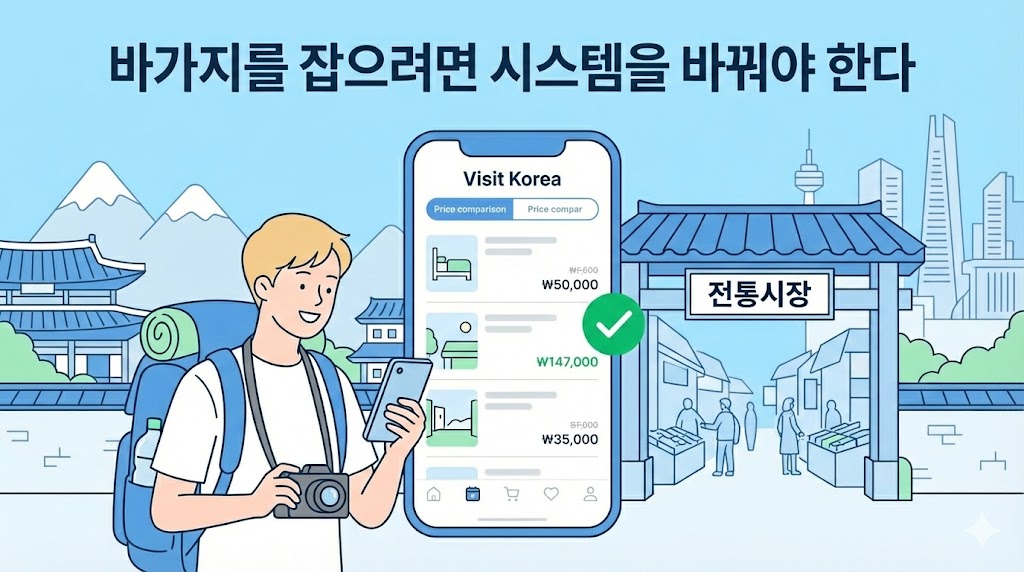
- A room that cost ₩68,000 on a weekday shot up to ₩769,000 ahead of BTS's Busan concert. An investigation by the Korea Fair Trade Commission and Korea Consumer Agency found that weekend rates during the concert averaged 2.4× normal prices — and peaked at 7.5×.
- The government rolled out a pre-declaration system for dynamic pricing and a five-day suspension for violations in February 2026. The direction is right, but daily rate changes don't fit neatly into declaration forms, and no one has the staff to monitor nearly 60,000 properties.
- A rack rate standard, rate histories kept by channel managers, and verified guest reviews on distribution platforms shrink the room for gouging — without multiplying enforcement.
When the dates for BTS's Busan concerts (June 12–13, 2026) went public, a property in Busan's Dongnae District raised its weekday ₩68,000 room to ₩769,000 for show nights. That's more than 10×[1]. The Korea Fair Trade Commission and Korea Consumer Agency surveyed 135 Busan properties and found that concert-weekend rates averaged 2.4× their usual levels and peaked at 7.5×[2]. Seoul was no different. A motel in Jongno-gu that charged around ₩140,000 on a typical Saturday listed ₩500,000 for the BTS Gwanghwamun show[3].
Data from Korea's Tourism Complaint Center show that between November 2025 and January 2026, 213 price-gouging complaints came in. Of those, 138 concerned accommodation; 117 of the 138 involved one-sided cancellations and penalty charges around idol concerts. Foreign tourists filed 157 of the 213 complaints — 74% of the total[4].
The government moved. On February 25, 2026, a joint task force released its "Price Gouging Eradication Plan." As someone who wants nothing more than to see Korea become a tourism powerhouse, I fully support the direction. But from the ground, I'm not sure this goes far enough.
Four Pillars of the Government Plan
The plan announced by the government is summarised below[4]:
| Measure | Content |
|---|---|
| Pre-declaration of Dynamic Pricing | Properties submit rates by season in advance (e.g. annually) under a "Fair Price Assurance Scheme" |
| Stronger Sanctions | First violation: 5-day suspension (current: warning or corrective order) |
| Cancellation Penalties | Penalties for one-sided cancellations made to re-list at a higher price; standards for deposit refunds and compensation |
| Platform Cooperation | Government–platform MoU; participating properties get a "Fair Price" badge; upgraded review systems and countermeasures for fake reviews |
The plan drew on international examples. France fines businesses up to €15,000 (₩25 million) for failing to disclose pricing information; Germany imposes fines of up to €25,000 (₩42 million) for violating price-display rules[4]. In California, Penal Code §396 (Anti-Price Gouging Act) caps hotel and motel rate increases at 10% when a state of emergency is declared[5].
The diagnosis is spot-on. One bad experience with price gouging turns a foreign tourist's impression of Korea sour — and that one experience becomes their entire impression. But 18 years in this industry have taught me one thing clearly: enforcement and sanctions alone don't change the market.
Three Questions from the Field
Can an annual declaration capture daily rate changes?
Hotel rates change every day. Weekdays differ from weekends, low season from high season, and event dates from quiet dates. In the global hotel industry, Revenue Management — real-time pricing that responds to supply and demand — is the standard. The government plan mentions annual declarations as an example. An annual filing is a good-faith starting point, but hospitality is a business where no two days in 365 are the same, and one declaration can't capture that.
Who sets the threshold for "excessive"?
The government's own document lists "lack of rational pricing standards" as a core problem[4]. If the government leaves peak-season rate guidelines to industry self-regulation, someone still has to write those guidelines.
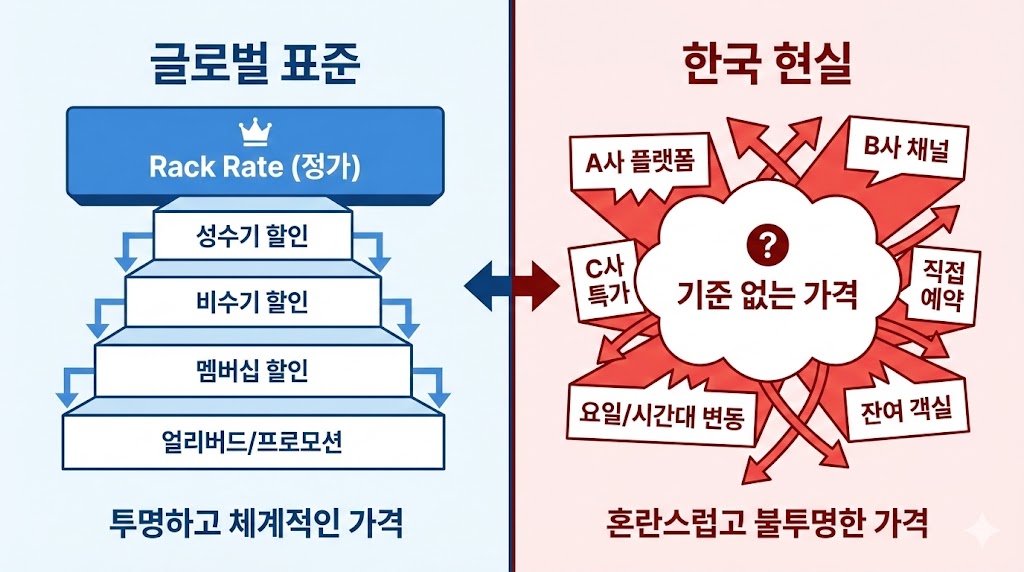
The global hotel industry has a concept called the Rack Rate — the official list price before any discounts or promotions. Think of it as the ceiling price. All discounts start from there, and consumers use the rack rate to judge whether today's price is high or low.
There's nothing wrong with prices rising with demand. Airline tickets routinely double or triple in peak season — that's Dynamic Pricing. The problem is raising a rate 10× without a reference price and without giving consumers enough information. Add collusion to the mix and it gets much worse. If consumers can see a reference rack rate, the choice is theirs — and the market's.
Korea's accommodation market has no such reference. The same room costs ₩60,000 on Yanolja, ₩50,000 on Yeogi Eottae, and ₩70,000 on yet another booking platform. Without a baseline, there's no way to judge what's reasonable.
Who can monitor 60,000 properties?
Lobin Company counts 59,619 accommodation businesses nationwide[6]. No one has the staff to watch rate changes at all those properties in real time. The Korea Fair Trade Commission and Korea Consumer Agency investigation of 135 Busan properties already required considerable resources. Scaling that up nationwide runs into hard physical limits.
The penalty level also deserves scrutiny. If an operator can pocket ₩5 million over a concert weekend, a five-day suspension won't deter them. The arithmetic is simple: the illicit gain outweighs the sanction. Without fines on the scale of France (₩25 million) or Germany (₩42 million), the effectiveness is questionable.
Systems Over Spotchecks
As someone who runs a hospitality IT company, I approach this subject very carefully. But I've never seen enforcement alone change this market, so I wanted to share a perspective as objectively as I can. I believe the core of this problem isn't catching bad actors — it's building a structure that makes gouging impossible.
Price Transparency is a Tech Problem
France has required since 2016 that accommodation properties display that night's double-room rate on the building exterior, near the entrance. The sign must state whether breakfast and Wi-Fi are included, and all prices must be tax-inclusive[7]. When the price is visible from the street, an absurd rate stands out immediately. That visibility is the intended effect of the disclosure rule.
Korea can apply the same principle — just digitally instead of on a wall. When properties manage rates through a channel manager or property management system (PMS), the system logs rate changes over time automatically. Instead of manual annual filings, the system keeps a real-time rate history and triggers alerts when abnormal swings are detected. You don't need humans to spot-check 60,000 properties — the data does the checking.
Reviews Filter Out Gouging
On OTAs with verified-stay reviews, only guests who've stayed can write reviews. If a ₩70,000 room on one of those OTAs gets listed at ₩770,000, the bad reviews come fast, the score drops, and the property slides down the search rankings until bookings dry up. The market self-corrects through ratings before regulators step in.
The contrast with an ad-driven ranking is stark. A 2023 Korea Consumer Agency survey found that 100% of the top-ranked motel listings on Yanolja and Yeogi Eottae were paid placements. The "Recommended" label mixed ads into organic results, making it hard for consumers to tell them apart[8]. A 2021 Korea Federation of SMEs survey found that 92.4% of businesses using accommodation apps considered the ranking logic unfair[9].
Review-driven OTAs have paid listings too, so they're not perfectly fair. But their core algorithms weigh review scores, conversion rates, and price competitiveness — quality signals that give better properties a real shot at ranking high. That's fundamentally different from a structure where ad spend alone determines placement. Properties that gouge don't need government enforcement to get weeded out — the system does it.
How France Rebuilt the OTA Ecosystem
France went a step further. The 2015 Macron Law invalidated OTAs' Price Parity clauses, letting hotels offer lower rates on their own websites than on OTA platforms[10]. Germany's Federal Cartel Office likewise banned the parity clauses of major OTAs in 2013 and 2015, and the Federal Court of Justice upheld the bans in 2021. Properties gained the freedom to grow direct channels. When you're not 100% dependent on platforms, pricing power returns to the operator, and the platform's ability to distort prices shrinks.
Korea needs to think in this direction. When operators have their own channels and also list on multiple OTAs, price transparency emerges naturally within that ecosystem.
Tourism Infrastructure AI Can Read
France used legislation; review-driven OTAs used algorithms. Both cleaned up their markets. Now we're living through an AI revolution everyone can feel, and I'm someone riding that wave head-on. So I want to introduce one more topic. Travellers now ask ChatGPT, "Recommend a good-value place to stay in Seoul." The properties AI recommends and the data AI trusts are beginning to shape travellers' choices.
AI reads structured data. When rate histories, review scores, facility specs, and government certifications are systematically organised, AI judges the property trustworthy. If the "Fair Price" badge on a platform is exposed in a machine-readable format, AI services worldwide can use that signal. The government's certification scheme, platforms' price data, and properties' facility information need to converge into a single digital ecosystem. I've covered the factors AI uses to recommend a property in a separate piece: How to Get Your Hotel Recommended by AI.
Korea has companies with deep experience standardising and globalising accommodation inventory. When that on-the-ground know-how meets the government's policy direction, "a country without gouging" can become more than a slogan — it can become a system.
A Country Where Gouging Can't Happen
Of course there are operators who gouge, but most of the owners I've met run transparent, honest businesses. It's painful that a minority's behaviour taints them by association. I think this government plan points in the right direction.
Add visible rack rates, data-driven rate monitoring, and distribution channels where reviews work properly, and you shrink the space for gouging without multiplying enforcement. Korea then moves beyond catching price gougers to becoming a country where gouging can't happen — a tourism destination the world trusts.
References
- Kyunghyang Shinmun, "Busan room rates jump 10× to ₩770,000 ahead of BTS June concert" (2026.1.15) · khan.co.kr
- Korea Fair Trade Commission, "Busan Accommodation Market Survey Results" (2026.2.13) · korea.kr
- Money Today, "'Even motel-grade properties at ₩500k/night': BTS comeback windfall crosses the line on lodging rates" (2026.1.26) · mt.co.kr
- Joint Task Force, "'Never Again' Korea: Building a Country Worth Revisiting — Price Gouging Eradication Plan Announced" (2026.2.25) · korea.kr
- California Penal Code, "Section 396" · california.public.law
- Lobin Company, "Korea's Accommodation Market 2024: Nationwide" (2025.4.15) · lobin.co
- Légifrance, "Order of 18 December 2015 on the public display of prices for commercial tourist accommodation other than furnished tourist accommodation and open-air hotels" (2015.12.18) · legifrance.gouv.fr
- Korea Consumer Agency, "Top listings on accommodation booking platforms — mostly paid ads?" (2023.5) · kca.go.kr
- SME News, "94.8% of businesses on accommodation apps say 'commissions and ad fees are excessive'" (2021.2.4) · kbiznews.co.kr
- Légifrance, "Article L311-5-1 - Tourism Code" (2015.8.8) · legifrance.gouv.fr
Frequently Asked Questions
- What does the government's price gouging crackdown include?
- It was announced on February 25, 2026, by a joint task force of ministries. Key measures include the Fair Price System (voluntary price pre-reporting system) where lodging establishments pre-report prices by season, a 5-day business suspension for first violations, sanctions against unilateral booking cancellations for the purpose of price increases or resale, and a 'Fair Price Establishment' label for properties partnering with platforms.
- Why is price pre-reporting alone insufficient?
- Accommodation rates change daily based on weekdays versus weekends, low season versus peak season, and local events. A price list reported at fixed intervals cannot capture actual selling prices, and it's impossible to manually inspect all 59,619 lodging establishments nationwide.
- How do you build a system that prevents price gouging?
- A publicly visible rack rate, automatic pricing history recorded by channel managers or PMS, and sales channels where rankings reflect actual guest reviews must all work together. This reduces opportunities for price gouging without increasing enforcement.