Summary
- The Yufuin ryokan I stayed at with my mother in 2015 was hard to reach and we had to sleep on futons laid over tatami. Yet it was fully booked. What the ryokan sold wasn't rooms — it was a day's experience woven from kaiseki cuisine and hot springs.
- Foreign arrivals to Korea hit a record 18.94 million in 2025, but the repeat-visit rate fell to 56.6% — still below pre-COVID levels (58.3%). Culinary tourism topped visitors' activities, yet Korean food remains a scatter of individual experiences.
- If regional stays package Korean food and local stories into overnight products, equip themselves with multilingual guides, card payments and English booking, Korea can become a country people return to.
Eleven years ago — summer 2015. I'd just handed over management of my second startup to Yello Mobile. My mother, my younger sister and I boarded a flight to Fukuoka. It was a long-overdue family trip and a short break for myself after years of the "I'm too busy with the business" excuse.
My mother isn't big on travel, but she loves Japanese food and prefers rest over sightseeing — so a Japanese ryokan it was. Given her motion sickness, I picked a destination with a short flight. That narrowed it down to a ryokan in Yufuin. The cost wasn't small, but it was our first family trip since my father passed, so I splurged and booked through a travel agency.
At Fukuoka Airport a guide holding a sign with my name in Korean led us to a worn minibus. The ride was as bumpy as the vehicle looked old. After an hour-plus of mountain roads you'd expect on the way to a lodge somewhere in the Taebaek range, we arrived at a remote hillside. Greeting us: a slightly dated but well-kept traditional ryokan and staff in Japanese dress. After the customary (slightly exaggerated but genuinely warm) Japanese welcome, green tea and tending to my queasy mother, we found ourselves being shown to our room.
The room was tatami. We'd have to pull out and lay futons to sleep. Oh no. This was supposed to be a treat for my mother, who can't sleep without a bed — and I'd paid this much for a place that gave us futons instead. I hadn't checked closely enough. My mistake.
Inconvenient access, shabbier-than-expected facilities, tatami you set up yourself. Up to that point I couldn't fathom why anyone would pay this price. Stranger still: the ryokan was nearly full. Apparently plenty of people willingly paid this much to stay here.
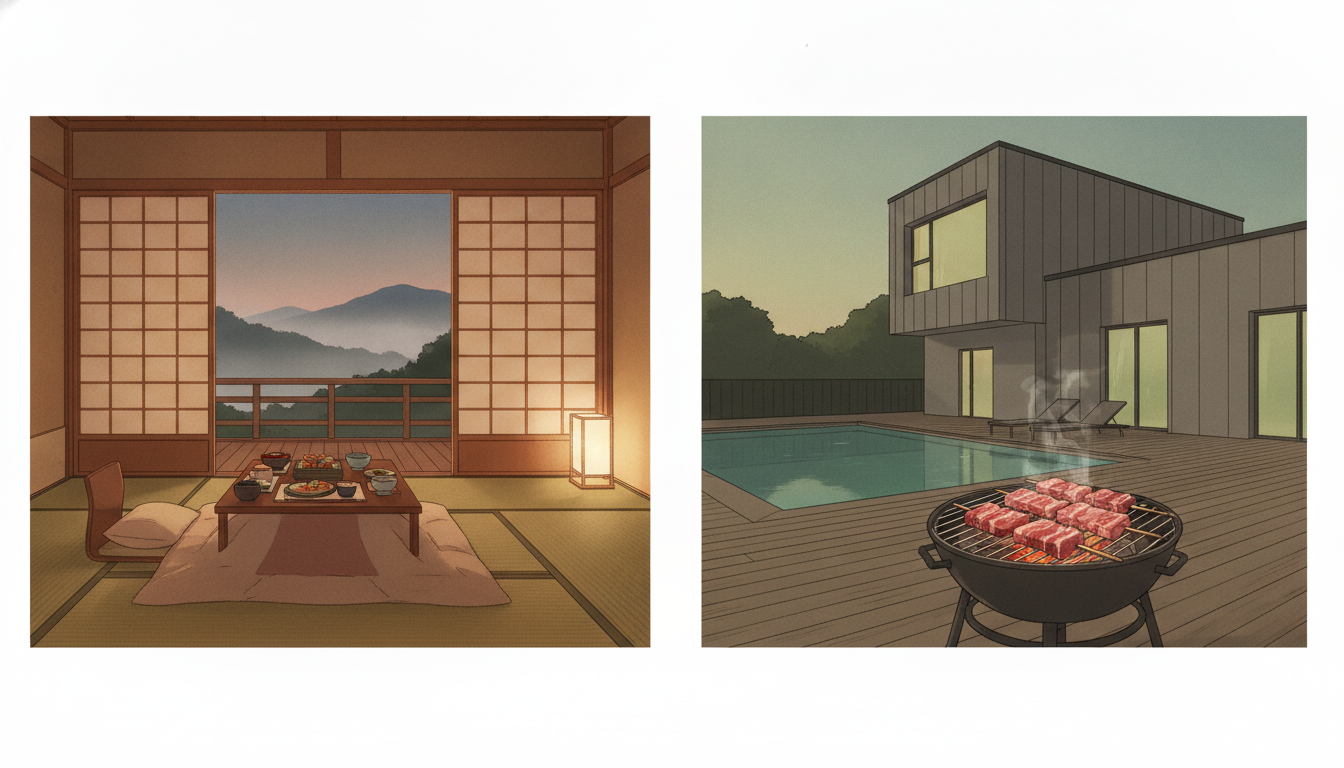
But over the two days the value started to reveal itself. Signs and instructions in multiple languages dotted the facility so foreign guests wouldn't feel lost. Every staff member we passed embodied the perfected form of Japanese hospitality. What stuck with me most was the kaiseki service — the multi-course traditional Japanese dinner brought course by course to the room. The nakai (room attendant) delivered each dish, and by the time we finished eating she'd already laid out the futons and slipped away. When my mother — worn out from the journey — noticed, her face brightened in a way the multi-generational hot spring water alone couldn't have managed.
Ordinary Things Become Products
Yufuin is a tiny hot-spring town of fewer than 10,000 residents. According to Yufu City's tourism survey, foreign visitors to Yufu (which includes Yufuin) hit 1.44 million in 2024 (person-visits), up 40% year-on-year — a new record[1]. Shirakawa-go, a mountain gassho-style village of around 500 residents, recorded 2.08 million visitors in 2024, over half of them (1.11 million) foreign[2]. Neither place's popularity rests on extraordinary resources alone. Shirakawa-go's thatched houses aren't larger in scale than Hahoe Village or Naganeupseong Folk Village.
Yet they became products. There was a story explaining why you should come all this way, and the guidance and amenities were woven throughout so foreign visitors could read, eat, sleep and experience that story.
The Korea Culture and Tourism Institute projects a record 22 million foreign arrivals in 2026[3]. Meanwhile France already welcomed 100 million foreign tourists in 2024, generating €71 billion in tourism revenue[4], and Spain received 93.8 million (up 10.1% year-on-year per Spain's INE)[5]. Even France — a tourism superpower drawing 100 million a year — wasn't built in a day. Countries that crossed the tourism-nation threshold ahead of us have been refining their stories for decades, in some cases over a century.
Not Kaiseki — Korean Food
Korea is now emerging as a genuine cultural powerhouse. Interest sparked by K-pop and K-dramas has expanded beyond content into the pillars of daily life: fashion, food, and even Hangul and the Korean language.
The Korean food craze is particularly striking. In the Ministry of Culture, Sports and Tourism and Korea Culture and Tourism Institute's 2025 Survey on Foreign Tourists, the activity visitors most considered when planning trips to Korea was culinary tourism (61.7%), and it was also what they did most (81.6%)[6]. The Korean Food Promotion Institute and Ministry of Agriculture, Food and Rural Affairs surveyed 11,000 consumers across 22 global cities for the 2025 Overseas Consumer Survey on Korean Food: satisfaction among those who'd tried Korean food hit 94.2%, and intent to eat it again crossed 80% for the first time (80.6%)[7].
Yet in Korea's tourism today, Korean food remains a scatter of individual experiences. Buldak bokkeum-myeon and Shin Ramyun at convenience stores, chimaek at Euljiro hole-in-the-walls, yangnyeom galbi in Cheongdam-dong — each sits in its own silo.
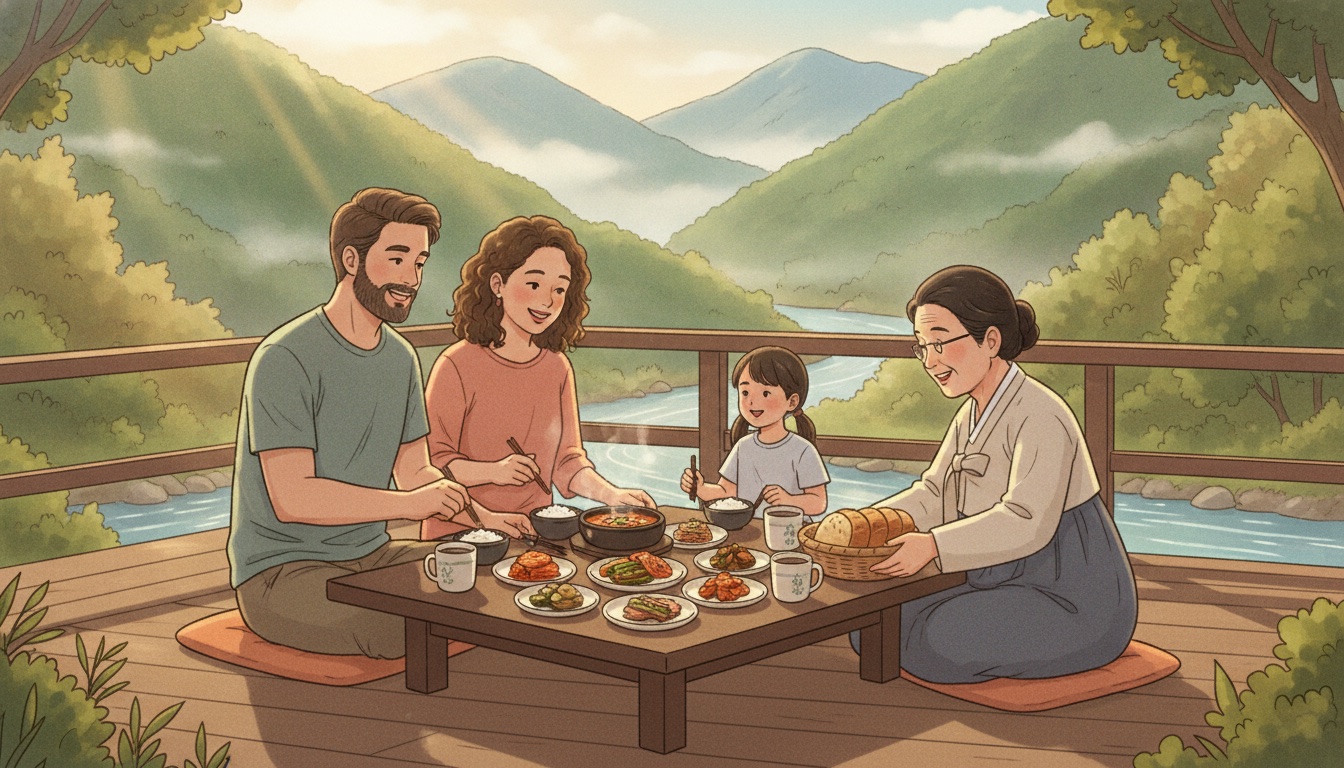
What if these came together under the banner of tourism? Imagine boarding a fishing boat off Sokcho's coast in Gangwon-do, catching rockfish and eating the sashimi right there. Or visiting a mill in Yangpyeong, watching freshly extruded garaetteok get sliced and turned into tteokbokki on the spot. It doesn't have to be hands-on. If a pension in Gapyeong — two hours from Incheon International Airport — or Namhae — two hours from Gimhae International Airport — could present Korean food not as individual dishes but as a cohesive offering (even if not quite kaiseki-level), wouldn't that experience justify several hundred thousand won a night? What the Yufuin ryokan sold wasn't rooms. It was an experience and a story woven from lodging, meals and hot springs.
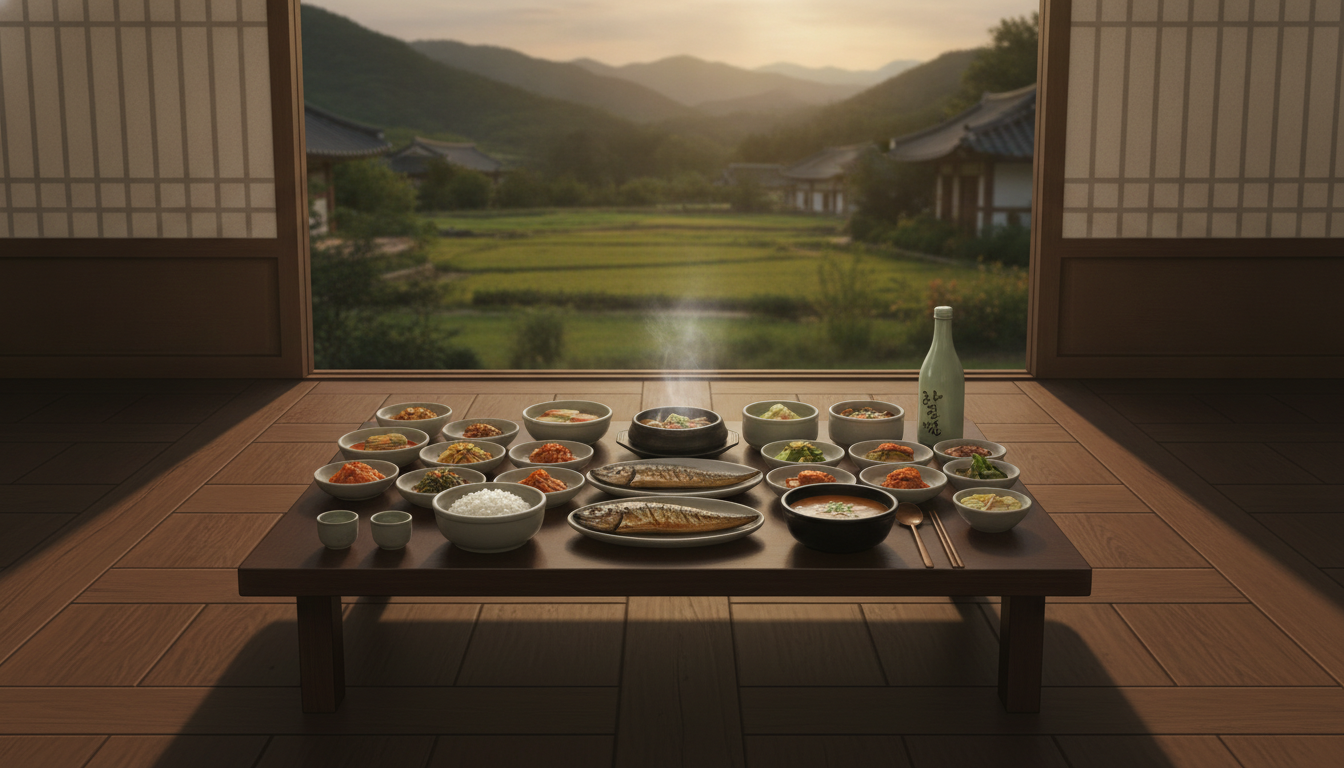
What we lack today isn't content — it's the editorial ability to weave these elements into a more valuable story, connecting them into one experience. Then we need to make that story accessible to foreign tourists, not just domestic ones: multilingual menus and guides posted throughout. Korean warmth is already a point of pride, and with AI translation advancing rapidly, communicating with foreign guests is no longer a hurdle.
A Country You Visit Once
The Korea Tourism Organization reports Korea received 18.94 million foreign visitors in 2025 — a record high, up 15.7% year-on-year[8]. That same year Japan welcomed 42.68 million (per the Japan National Tourism Organization's estimate)[9], and the Japan Tourism Agency tallied foreign visitor spending at ¥9.5 trillion[10].
But the gap that catches my attention isn't the absolute numbers — it's the repeat-visit rate. According to the Survey on Foreign Tourists, Korea's repeat-visitor rate dropped from 58.3% in 2019 to 54.7% in 2024, then edged up to 56.6% in 2025 — still below pre-COVID levels[6]. Arrivals hit an all-time high, yet the share of people returning is lower than before COVID. And 76.8% of visitors still go to Seoul — almost unchanged from 2019 (76.4%)[6].
We all probably know why. They came curious about Korea, K-pop, the backdrops and dishes from K-dramas — but Korea hasn't matured as a tourism destination the way Japan or France has. Between a country where menus still translate yukhoe (beef tartare) as "six times" and a country that brings kaiseki to your room, it's obvious which one you'd want to visit again.
Not long ago I wrote about how catching overcharging requires systemic change, not just enforcement. I see the same root cause behind our tourism's lack of sustainability. As long as we have a culture of gouging visitors who've flown thousands of miles — treating them as one-time customers — today's curiosity will likely cool before long.
To Become a Country People Return To
How long the K-content wave will last is anyone's guess, but current trends suggest it won't fade quickly. The Korea Foundation and Ministry of Foreign Affairs surveyed 119 countries and found roughly 225 million Hallyu fans worldwide as of end-2023[11]. K-content was also the top reason (40.1%) visitors cited for wanting to travel to Korea[6].
Yangpyeong or Gapyeong are two hours by car from Incheon Airport. Gangneung is two hours by KTX from Seoul Station. Widen the lens to Gimhae International Airport and Yangyang International Airport, and the number of regional towns foreigners can reach grows significantly. To an American used to vast distances, these are practically next-door. Within that radius we can weave Korean culture into experiences worth several hundred thousand won a night.
To do that, each region needs a story explaining why you should come here. Signs, menus, apps and maps should be fluent in at least three languages. Card payment can't be the reason a guest doesn't order the barbecue. You don't have to bring kaiseki-style room service — but there should be a place to experience Korean food within walking (or short driving) distance of the stay. Local restaurants and accommodations can become each other's product. Packages bundling breakfast and dinner with the room rate would work too. Why pensions need to sell breakfast instead of just rooms is a separate argument I made in 30 Years of Pensions: The Owner's Homemade Gimbap Handed Over at Breakfast.
We have Korean food that works anywhere in the world. The moment we layer it onto an overnight stay in the country people only saw in K-dramas, our lodging product transcends room rental and becomes a cultural product: experiencing a day in Korea. A pension's overnight stay can be plenty attractive with just Korean food and the local story — and that experience will give guests a reason to return.
The Korea Culture and Tourism Institute's 2019 analysis found that in depopulating regions, it takes 41.7 tourists to offset the consumption lost when one resident leaves[12]. The 92 regions re-designated as depopulating areas by the Ministry of the Interior and Safety in October 2026 have room to revive through tourism[13].
At ONDA I'm helping our lodging-owner clients fill bookings with foreign tourists by translating their websites (booking engines) into English, integrating international payment modules, and optimizing so ChatGPT and Gemini recommend them well. How AI picks accommodations is covered separately in How to Get Your Hotel Recommended by AI. Forward-looking owners are already pressing us to hurry, eager to welcome foreign guests. Whether they've prepared enough for visitors to actually enjoy the pension beyond just having an English homepage is another question. Starting now still leaves plenty of time.
The figure of 18.94 million annual visitors can grow much larger. I hope the regions thrive and Korea becomes a country visitors return to. This isn't about beating Japan. It's about becoming a country people come back to. We can do it, and our lodging-owner clients will make it happen.
References
- Yufu City Commerce and Tourism Division, "Regarding the Results of the Reiwa 6 Yufu City Tourism Trend Survey" (2025.5.23) · city.yufu.oita.jp
- Shukan Josei PRIME, "World Heritage Site Shirakawa-go Sees Tourist Influx Due to Inbound Boom — Asked Officials About Impact of 'Worsening Japan-China Relations'" (2026.3.1) · jprime.jp
- Asia Economy, "'Foreigners increased but spending decreased': Variables in the 22 million inbound tourism forecast" (2026.6.10) · view.asiae.co.kr
- Journal de l'économie, "Tourism: France attracts 100 million visitors in 2024" (2025.1.23) · journaldeleconomie.fr
- Spain's National Statistics Institute (INE), "Tourist Movement Statistics at Borders (FRONTUR)" (2025.2.3) · ine.es
- Ministry of Culture, Sports and Tourism / Korea Culture and Tourism Institute, "2025 Survey on Foreign Tourists Final Report" (2026.5.26) · know.tour.go.kr
- Korean Food Promotion Institute, "2025 Overseas Consumer Survey on Korean Food" (2026.1.6) · hansik.or.kr
- Korea Tourism Organization, "Announcement of Korea Tourism Statistics for December 2025" (2026.1.30) · datalab.visitkorea.or.kr
- Travel Voice, "[Infographic] Foreign Visitors to Japan Exceed 42 Million in 2025" (2026.1.21) · travelvoice.jp
- Travel Voice, "Inbound Travel Spending Up 16% to Record ¥9.5 Trillion in 2025" (2026.1.22) · travelvoice.jp
- Sayhikorean, "Global Hallyu fans surpass 200 million… becoming global pop culture" (2024.3.17) · sayhikorean.com
- Korea Culture and Tourism Institute, "Study on Economic Effects of Tourist Inflows to Depopulating Regions" (2022.12.13) · kcti.re.kr
- Money Today, "Dropped again in 5 years, 3 more depopulating regions added" (2026.10.8) · mt.co.kr
Frequently Asked Questions
- Why do ryokans stay fully booked despite high prices?
- They sell not just a room but a full day's experience woven from kaiseki dining, hot springs, and in-room service. Multilingual guides and amenities are provided throughout so international guests can enjoy their stay without inconvenience.
- What is the repeat-visit rate among foreign visitors to Korea?
- According to the International Visitor Survey, the rate fell from 58.3% in 2019 to 54.7% in 2024, then rose slightly to 56.6% in 2025. Although arrivals hit an all-time high, the proportion returning remains below pre-pandemic levels, and destinations are concentrated in Seoul, which attracts 76.8% of visitors.
- What should rural accommodations prepare to receive international tourists?
- You need a story that explains why people should come to the region, guides and menus in at least three languages, card payments, and a Korean-cuisine experience accessible without a rental car. Packaging breakfast and dinner with the room rate and an English-language website through which international guests can book are also valuable.