
Summary
- Fuel surcharges are spiking and Korea's on track for 20 million inbound visitors. Demand is surging again. The properties that ramped up fixed costs when the balloon inflated get hit hardest when it pops.
- Five rules: Turn fixed costs into variable ones. Base investment decisions on post-burst conditions. Diversify your channels. Prioritize occupancy over ADR. And bring guests back.
- Drop your ADR from ₩300,000 to ₩220,000 and lift occupancy from 40% to 70%, and RevPAR climbs 28%. Let systems handle what doesn't need a human touch, so you can spend time on guests.
Part 1 laid out the balloon-effect playbook:
External shock → Demand shifts → Pensions and villas surge → Budget alternatives benefit → Outside capital piles in → Supply glut → Demand normalizes → Price collapse
Supply glut never skips a turn. And the operators who get hurt most are the ones who locked in fixed costs during the boom.
The balloon's inflating again. Fuel surcharges jumped from tier 18 in April to the ceiling—tier 33—in May[1], and with Korea heading toward 20 million annual arrivals, Seoul hotels can't add capacity fast enough. Demand is coming back. There's opportunity in that—but only if you restructure your operations now.
It's 2 a.m. An alert wakes you: a Yanolja booking just overlapped with one from another OTA. You call one guest to apologize. Morning: check how many clicks your ad logged before the budget ran out. The place next door dropped their rate, so you drop yours. A message in English needs a translation tool.
Half that day didn't require you. When demand surges, that day just gets heavier. You need a structure that makes money when the balloon inflates and holds up when it pops. Here are five rules drawn from 18 years in the field.
Rule 1. Turn Fixed Costs Into Variable Ones
When the balloon deflates, fixed costs hit first. A Hotel & Restaurant analysis found that payroll averaged 29% of total revenue across Korean hotels in 2024—36% for five-stars[2]. Add rent, loan interest and maintenance. Revenue can get cut in half, but these bills keep clearing your account.
| Type | Fixed costs | Variable costs |
|---|---|---|
| Examples | Full-time payroll, rent, loan interest, maintenance contracts | Seasonal staff, part-timers, outsourced housekeeping |
| When revenue drops | Stays the same | Scales down with it |
The gap doesn't show when demand's overflowing—you're making enough either way. The gap opens when the balloon pops.
This isn't "cut all staff." If you need extra hands during peak season, lean on seasonal hires, part-timers and specialist contractors. Keep your full-time roster lean—just the core roles you can sustain even when the balloon deflates.
Technology can take over a lot of tasks. Online reservations, guest records, self-check-in, automated messages—if a human doesn't need to do it, putting a human on it inflates your fixed base. The energy you save there goes toward hospitality that drives repeat visits and word of mouth.
Right now demand is strong and bookings are rising. Don't reflexively add fixed costs. Use tech and external services to build a variable-cost structure that can handle today's volume. Ironically, when demand's weak, you don't have the luxury to think this through. That's why now is the window.
Rule 2. Base Investments on Post-Burst Conditions
In 2020–21, when the balloon was at peak inflation, some operators made big calls: add a villa wing, build a pool villa, go all-in on a renovation. They ran payback projections based on prevailing ADR and occupancy—three years to break even. The balloon popped. Occupancy halved. The payback period went from three years to ten. There wasn't enough cash flow to last ten.
Run your payback math not on today's revenue but on what's left after the balloon pops. Weekend occupancy might be 95% and ADR ₩300,000 right now—don't finance the project with those numbers. Externally driven booking spikes don't last. Ask: "Can I handle this at 60% occupancy and ₩200,000 ADR?" Only invest if the answer is yes.
Construction has a saying: "Break ground in a boom, open in a bust." Hospitality's the same. A pool villa you start today finishes in two or three years, and nobody knows where the balloon will be by then. If you're thinking about expansion, start with the question: "Can I still pay this back after the balloon pops?" If the answer doesn't come quickly, step back and give it more time.
Rule 3. Spread Your Channels
When the balloon's inflated, listing on one or two channels fills your calendar. Sticking to a single OTA keeps admin simple, and their promotions pull bookings. You're making money, so you splurge on a few million won in ads. Bookings seem to climb.
But when the balloon deflates, the more you leaned on one channel, the more exposed you are. Each OTA has limited top-tier inventory spots, and the only reliable way to rank above hundreds of competitors is to pay more. The property next door raises its ad spend, so you raise yours. It's zero-sum.
The properties most dependent on a single OTA panic when bookings drop and throw even more budget at top placement—often outspending what they allocated during the boom. Revenue's down, but costs are up. If one channel accounts for over 80% of your revenue, you're at the mercy of that platform's policy changes, algorithm tweaks and commission hikes.
Trying to diversify after the balloon pops is too late. Reviews, rankings and visibility on new channels don't materialize overnight.
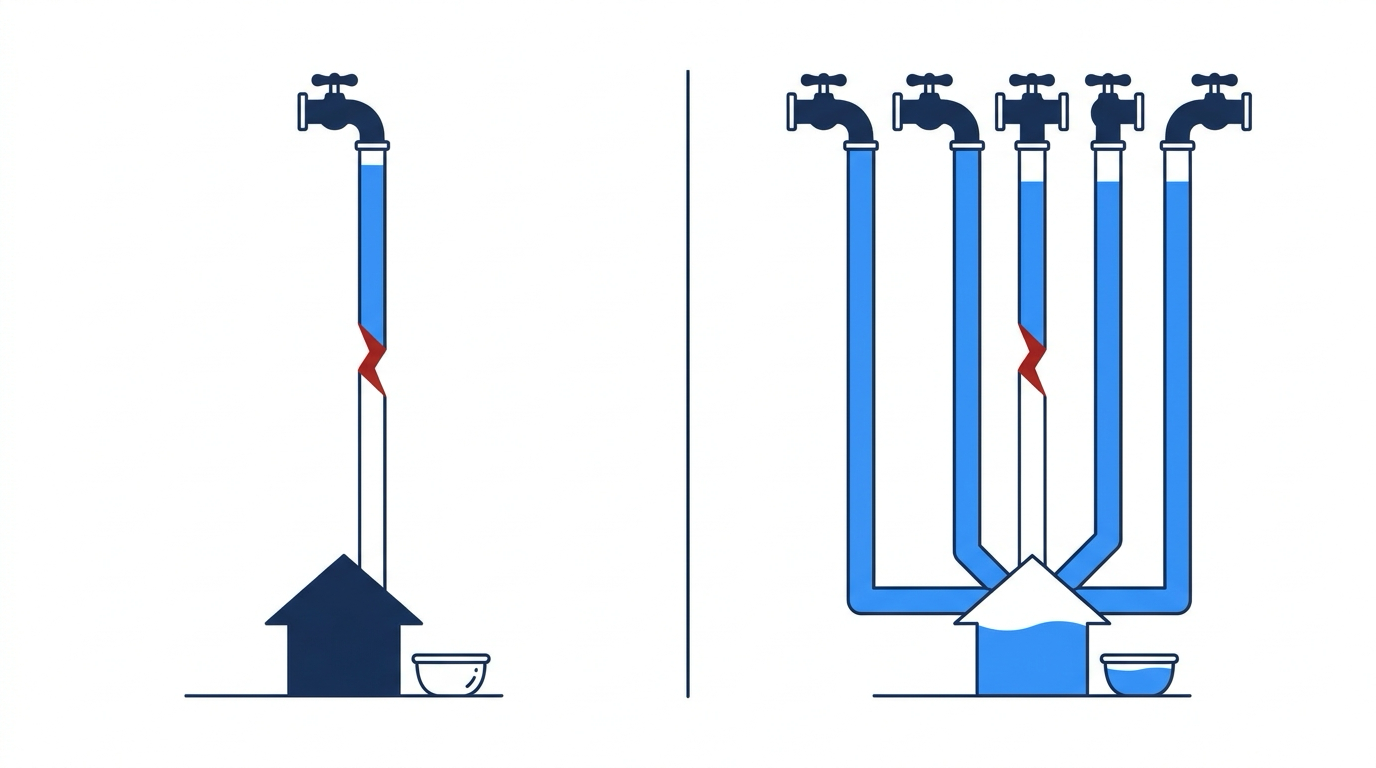
Three things to do now:
- While bookings are strong, list on more channels and start building reviews and reputation.
- Keep any single channel under 80% of total revenue.
- Set up your own AI-readable website.
If AI can't discover your property, you don't exist
In an AI-first world, channel diversification includes your direct presence. Gartner forecasts traditional search-engine volume will drop 25% by 2026 due to AI chatbots[3]. A Phocuswright report from March 2026 found 56% of US travelers used AI for trip planning at least once in the prior year[4]. People type "Recommend a good place in Gangwon-do for two nights" into an AI interface, not a Google search bar.
But Skift's April 2026 analysis showed that when AI was asked about Hyatt hotels, the most-cited source wasn't Hyatt's own site (10.3%)—it was the financial-info site NerdWallet (13.6%)[5]. Even global chains get outranked in AI citations by third parties. Hotel sites focus on selling rooms, not answering the questions guests ask.
That's why your direct channel needs to be an AI-readable website now. English support, international card processing, Schema markup, AEO (Answer Engine Optimization)—too much for an operator to manage alone. The next generation of channel managers should bundle all of this by default. The criteria AI uses to pick properties are covered separately in How to Get Your Hotel Recommended by AI.
Rule 4. Prioritize Occupancy Over ADR
The metric that matters most in hospitality is RevPAR (Revenue per Available Room)—how much you actually earn per sellable room. According to Lobin Company's 2024 Korea accommodation report, the national average was ADR ₩112,000, occupancy 66.4%, RevPAR ₩74,000[6].
When the balloon deflates, many operators try to defend ADR first. "My property is worth ₩300,000—I can't sell it for ₩200,000." Say your ADR is ₩300,000 and occupancy is 40%. RevPAR is ₩120,000. Drop the rate to ₩220,000 and occupancy climbs to 70%. Now RevPAR is ₩154,000. You cut price 27% but lifted RevPAR 28%.
Higher occupancy brings ancillary revenue—F&B, experiences, amenities—plus better operational efficiency and more reviews. Empty rooms generate nothing.
I understand the pride in "protecting your property's value." But in a deflating market, clinging to price alone cuts off cash flow. Adjust rates flexibly by weekday/weekend, season and booking window. Manual adjustments hit limits fast, but next-gen channel managers and PMS platforms automate data-driven pricing.
Rule 5. Bring Guests Back
This last rule is the most important. Properties that weather balloon cycles versus those that don't—repeat guests make the difference.
Hospitality Net cites industry consultant Max Starkov: independent hotels average 10–15% repeat-guest share, while major chains hit 60%[7]. Harvard Business Review notes that acquiring a new customer costs 5–25× more than retaining an existing one, and research by Bain & Company's Frederick Reichheld (cited in the same piece) found that a 5% increase in customer retention lifted profit by 25–95%[8].
Repeat guests are less sensitive to the balloon. When OTA algorithms change or competitors slash rates, a guest who remembers "I'll go back there next time" still books.
Operators ask me all the time: "How much should I spend on ads?" I flip the question: "What percentage of your bookings come in without any ad spend?" The surest way to cut ad costs is to raise the share of guests who come back without prompting.
Repeat visits don't come from flashy facilities. They come from clean rooms, genuine hospitality and small but memorable moments. Greet guests by name at check-in. Remember which room they liked last time. Send a "Hope to see you again" message after checkout. Technology helps you act on those intentions. Log guest history in your PMS. Auto-send a thank-you after checkout. Offer a small perk when someone returns.
Guests remember the experience and the hospitality—not which channel they booked through or what they paid. That memory is your asset. When enough of those memories accumulate, you build a revenue base that pulls bookings without OTA commissions and holds steady whether the balloon inflates or deflates.
The Balloon's Inflating Again
I've spent 18 years in this industry watching the balloon inflate and pop. The 2003 Iraq War travel slump, the 2008 financial crisis, 2015 MERS, 2020 COVID. The external shocks had different names, but the pattern stayed the same. Operators who ramped up fixed costs during the surge took the biggest hit when the balloon popped.
That pattern is what drove me to start ONDA ten years ago. I watched operators exhaust themselves on channel admin, rate adjustments, foreign-language support and ad budgets—too drained to focus on guests. So we built a next-gen channel manager bundled with an English website, international payments and AI-driven rate recommendations. All so operators could spend their time on what they do best: welcoming guests, turning down beds, offering a warm hello.
Boil the five rules down to one line: Let systems handle what doesn't need a human, and focus your energy on hospitality. A property with systems but no hospitality feels cold. A property with hospitality but no systems burns out.
The balloon's inflating again. Another opportunity is coming. Take it—but first ask whether the costs you're about to add can survive the next deflation. Hand off to systems what systems can do, and spend the time you free up on guests. What guests remember longest is the time you gave them.
「Korea Accommodation Bubble」 series
- Part 1: Fuel Surcharge Spike—What's Coming for Your Property
- Part 2: Five Rules for Properties That Survive When the Balloon Pops (this piece)
References
- Smart Today, "International fuel surcharges hit record Level 33… are airlines' wings being clipped?" (2026.4.20) · smarttoday.co.kr
- Hotel & Restaurant, "[Feature] Will Room Rates Continue to Rise in 2026? Price Drivers and Strategic Responses" (2026.2.19) · hotelrestaurant.co.kr
- Gartner, "Gartner Predicts Search Engine Volume Will Drop 25% by 2026, Due to AI Chatbots and Other Virtual Agents" (2024.2.19) · gartner.com
- Phocuswright, "The AI Surge: Travel's Fastest Behavioral Shift in a Decade" (2026.3) · phocuswright.com
- Skift, "Hotels and Airlines vs. NerdWallet and Reddit: Who's Winning in AI Visibility" (2026.4.17) · skift.com
- Lobin Company, "Korea Accommodation Market 2024: Nationwide" (2025.4.15) · lobin.co
- Hospitality Net, "Why guest retention is the #1 priority for hoteliers in 2025?" (2025.1.7) · hospitalitynet.org
- Harvard Business Review, "The Value of Keeping the Right Customers" (2014.10.29) · hbr.org
Frequently Asked Questions
- Is it really a bad idea to hire more staff when demand grows?
- It's safer to cover peak-season labor with variable costs—seasonal workers, part-timers, or outsourced cleaning services. Regular payroll stays fixed even when revenue drops, so permanent headcount is the first thing to shake your property when the bubble deflates.
- What criteria should I use for expansion or renovation investments?
- Calculate payback periods using post-bubble figures, not today's occupancy and rates. If you can't immediately say 'yes' when asked whether the investment makes sense at 60% occupancy and 200,000 won per room, it's better to step back.
- Won't I lose money by lowering prices in the off-season?
- In hospitality, revenue per available room (RevPAR) matters more than rate alone. At 300,000 won with 40% occupancy, your RevPAR is 120,000 won. Drop the rate to 220,000 won to achieve 70% occupancy, and RevPAR rises to 154,000 won—28% higher.