Summary
- Motels account for 51.5% of Korea's total room supply. Yet every owner says business has gotten worse. OTA commissions (averaging 11.5%) and advertising costs drain roughly 20% of revenue.
- Day-use demand, long driven by couples seeking privacy, is collapsing. Marriages have fallen to less than half the 1996 figure. Single-person households now make up 36% of all households. Meanwhile, minimum wage, gas bills, and interest rates have all climbed.
- 2025 set a record with 18.94 million inbound visitors. But most motels aren't ready to host foreign guests. For those travelers, these properties simply don't exist. That's the paradox of 51.5%.
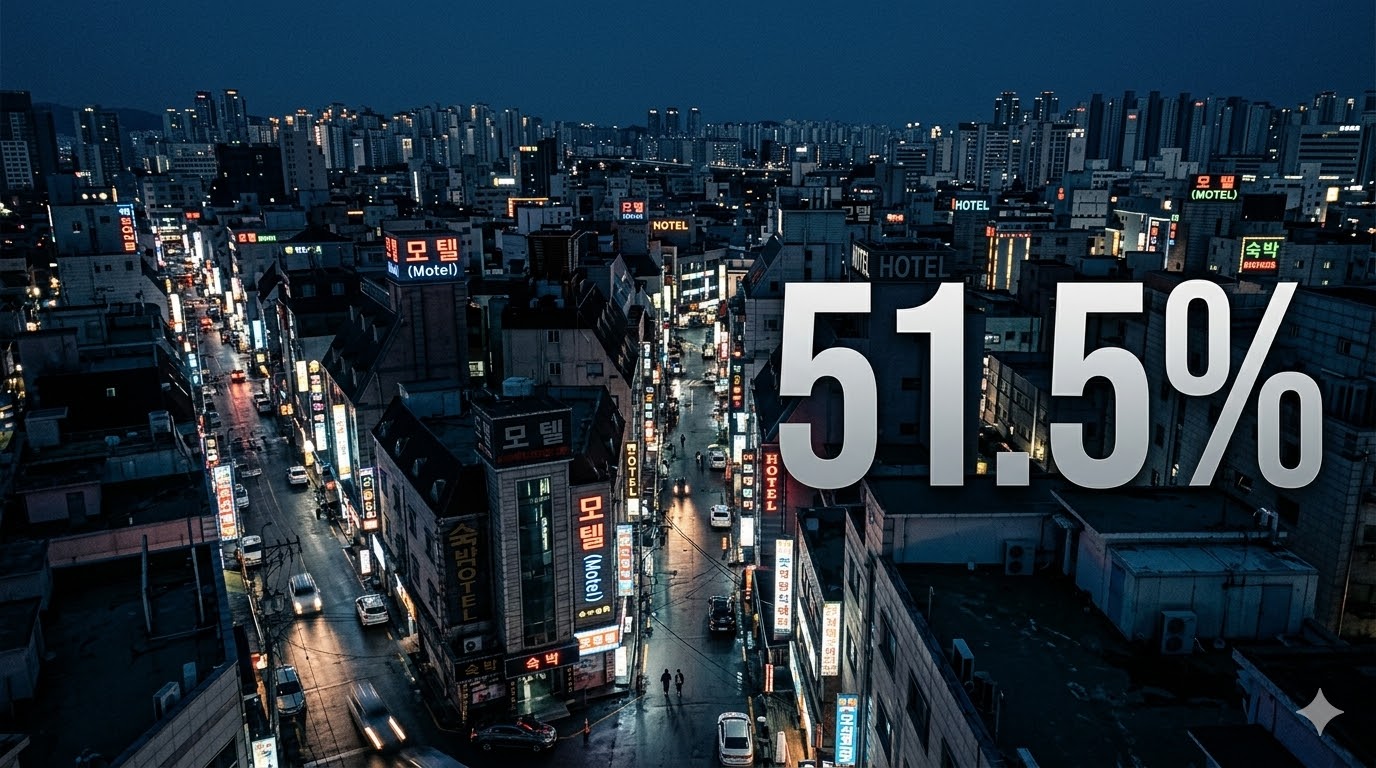
According to Lobin Company's 'Korea Lodging Market 2024', there were 59,619 lodging establishments nationwide in 2024, and motels (legally classified as yeogwan) account for 51.5% of the total sellable room inventory[1]. That's more than half the market. Yet recently, owners across this massive segment have been saying the same thing:
"It's never been this hard."
I've spent 18 years in hospitality and run ONDA for 10. We've worked with thousands of properties. Over the past few years, motel owners' faces have noticeably darkened. Stories of spending hundreds of millions on renovation only to struggle covering the interest payments no longer surprise anyone. Revenue is growing on paper, but the ground reality is all pain. Call it the 51.5% paradox.
The battlefield changed. The war didn't end.
Yanolja and Yeogi Eottae are names motel owners both appreciate and resent. Industry estimates put 80% or more of small and mid-sized motel revenue in the hands of these two apps[2]. Walk-in traffic keeps shrinking. Without the apps, there's no business — but the price is steep.
In 2024, the Korea Federation of SMEs surveyed 1,103 small and mid-sized companies selling through online platforms. Below are the results for the lodging app segment[3]:
| Item | Figure |
|---|---|
| Average sales commission | 11.5% (range: 8–17%) |
| Average monthly ad spend | ₩1,079,300 |
| Commission + ads combined | ~20% of revenue |
Sell a ₩50,000 room, and at least ₩10,000 goes to the platform. On top of that, over ₩1 million in monthly ad spend walks out the door every month. Don't advertise, and no one finds you. Competitors do advertise, so ad costs spiral upward with no ceiling.
Platform economics predicted this outcome. Early on, demand outstrips supply, so the platform favors suppliers. There was a time when simply listing a room brought guests. My first startup, HaninTel, worked that way. So did Yanolja and Yeogi Eottae.
But Korea is a closed market of 50 million people. Domestic demand growth hits a ceiling. Once supply catches up, competition moves inside the platform. The ad-spend war for top placement becomes rent-seeking — costs rise, but the pie doesn't grow. Offline neon signs and flyers gave way to online ad budgets. The expense just changed channels.
The Korea Fair Trade Commission knows the structure is broken. In August 2025, it fined Yanolja and Yeogi Eottae a combined ₩1.54 billion. The two companies sold coupon-based ad products to listed properties, then let unused coupons expire without refund. Yeogi Eottae set coupon validity at just one day — unused coupons auto-expired, totaling ₩35.9 billion in forfeited value[4]. In September 2025, the Korea Federation of Small and Mid-sized Hotels filed a class-action lawsuit against both companies, estimating 5,000 to 8,000 affected properties[5]. In January 2026, the Ministry of SMEs and Startups asked the KFTC to prosecute the companies[6].
Fines and lawsuits are in motion, but the structure isn't changing. Without the platforms, there's still no business. Stay off them and you die. Stay on them and you break even at best.
Day-use demand is evaporating
Day-use was the core of motel economics. Morning session, afternoon session, then overnight — turn the room two or three times a day. Overnight-only revenue doesn't cover the bills. You need occupancy above 100% to break even. A decade ago, owners said, "Just capture the couples." Now the landscape is completely different.
The couples who drove day-use demand are going out less. According to the Korean Statistical Information Service (now National Data Service), marriages in 2022 hit a record low of 192,000 — less than half the 435,000 recorded in 1996[7]. Single-person households reached 8.045 million in 2024, or 36.1% of all households, up from 27.2% in 2015[8]. As more people live alone, couples have less reason to rent a room for privacy. A 2024 PMI survey found 75.8% of unmarried men and women were not dating[9]. According to the Korea Information Society Development Institute, OTT usage hit 89.2% in 2024[10]. For couples, ordering delivery and watching Netflix at home is cheaper and more comfortable than checking into a motel.
For a key customer segment, the motel's real competitor isn't the motel next door — it's their own apartment.
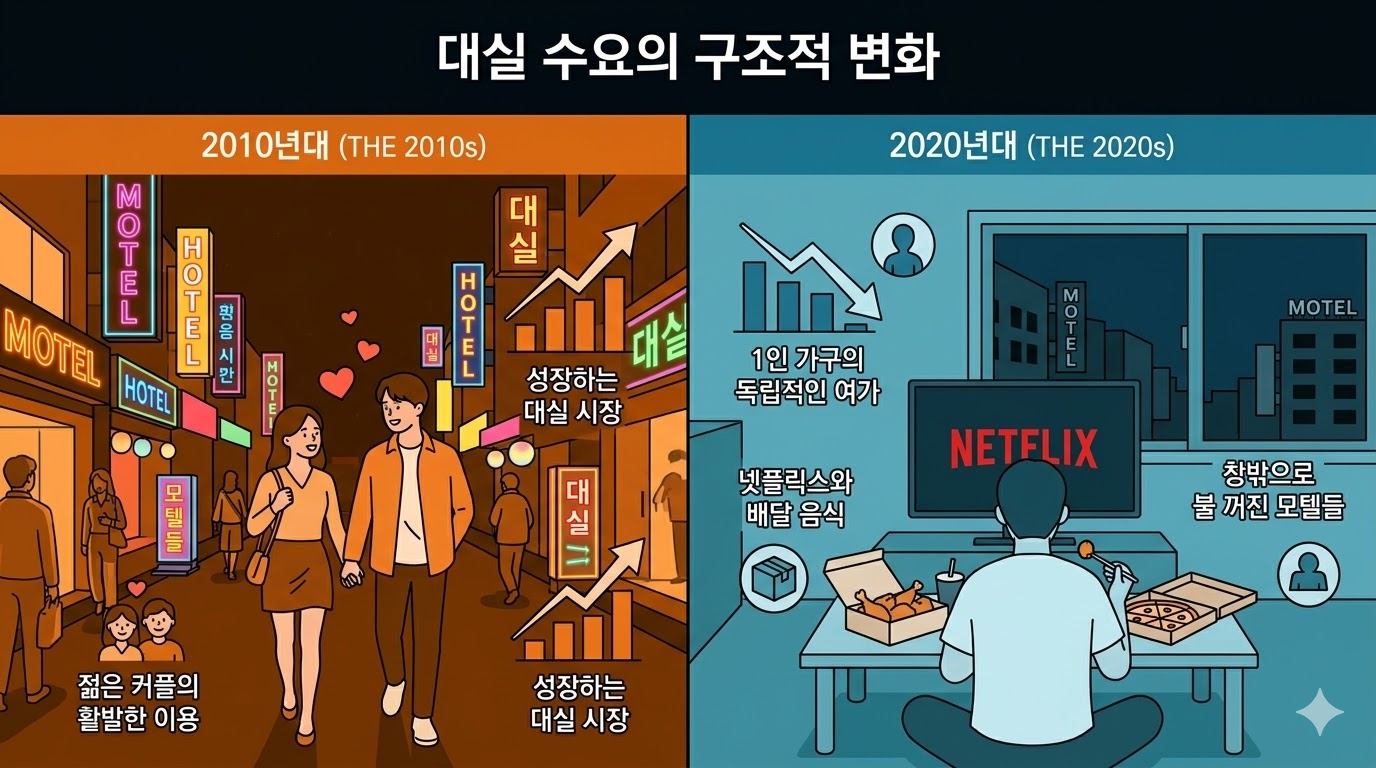
Gen Z, many still living with parents, now prefer home-sharing or boutique stays over motels when they do go out. A generation that posts to Instagram wants "Instagrammable" spaces, not dimly lit motel corridors. To capture shrinking demand, you have to compete on design. Newly opened or freshly renovated motels pull traffic. But the effect lasts one to two years. To stay relevant, you need to reinvest hundreds of millions every two to three years.
Day-use also carries hidden operating costs. Every checkout triggers housekeeping, linen change, and restocking. Turn a room three times, and you clean three times. Labor, laundry, and consumables stack up with every cycle. The higher the turnover, the higher the cost — but fierce competition means raising day-use rates sends customers to the motel next door.
Meanwhile, costs only climb. Minimum wage rose 80% over a decade, from ₩5,580 in 2015 to ₩10,030 in 2025. Residential city gas rates went up six times between 2022 and 2024. The Bank of Korea's base rate climbed from 0.5% in 2021 to 3.5% in 2023, and even after cuts it's nowhere near the ultra-low era. For owners carrying hundreds of millions in debt, the interest burden is incomparable to the past. Revenue holds flat while costs squeeze from all sides — a classic cost squeeze. High turnover, zero margin.
Half the market is missing the foreign guest boom
Everything up to this point is familiar territory for motel owners. Everyone nods at the high platform fees and the day-use collapse. But on the other side of the market, the exact opposite is happening.
According to the Korea Tourism Organization, 18.94 million foreign tourists visited Korea in 2025 — an all-time high[11]. Yanolja Research forecasts over 20 million in 2026[12]. K-pop, K-drama, and K-beauty fandom is converting into real travel demand.
In 2016, 8.06 million Chinese tourists came to Korea, and Seoul hotels ran out of rooms[13]. The industry bused tour groups from Incheon Airport to Pocheon and other Gyeonggi-do suburbs, lodged them overnight, then brought them back to Myeongdong for sightseeing and shopping in the morning. A two-hour drive didn't faze Chinese tourists. With no rooms in Seoul, demand spilled into the outer metro area. A similar situation — bigger this time — is unfolding again.
From October 2025, a major home-sharing platform began fully enforcing mandatory business registration, and unregistered properties can't take bookings from 2026. Yanolja Research estimates roughly 34,000 of Korea's 72,000 home-sharing listings (47.7%) are unlicensed. AirDNA analysis showed 74% of Seoul and 92% of Busan home-sharing units were "entire home" rentals — de facto illegal[14]. Tens of thousands of rooms are disappearing from supply.
Supply should be growing to fill that gap, but it's not. According to the Asia Economy, Seoul's tourist hotel room count grew 23.8% from 2016 to 2019, but only 3.7% from 2020 to 2025. Even with recent construction permits up, hotels take roughly five years from permit to completion. Securities analysts expect Seoul hotel supply shortages to persist through 2029[15]. Given that inbound tourism growth is still in early innings, the supply crunch won't resolve quickly.
Yet motels — 51.5% of the market — aren't positioned to capture this opportunity. Foreign travelers don't book through Yanolja or Yeogi Eottae. For most motel owners, listing on the channels foreign guests use and managing inventory with a channel manager remains unfamiliar terrain. English feels daunting. The systems seem complex. So despite controlling half the market, they're invisible to 20 million foreign guests. That's the real paradox of 51.5%.
Face the problem to find the path
Motel owners aren't struggling because they lack diligence or effort. Inside a closed domestic market of 50 million, platform ad spend spirals upward, couple demand shrinks structurally, costs rise, but room rates can't budge. Within this closed loop, there's no way out.
Look outside, and the story changes. The supply vacuum we've outlined can be filled by the motels that make up half the market. The properties that prepare for foreign guests can move first.
Rediscovering the Motel series
- Part 1: 70 years of Korean motels, and the fifth evolution
- Part 2: Why motel owners are struggling (this post)
References
- Lobin Company, "Korea Lodging Market 2024: Nationwide" (2025.4.15) · lobin.co
- Korea Post, "Yanolja and Yeogi Eottae's 'advertising and commission bullying' controversy reignites" (2025.10.13) · koreapost.co.kr
- Newsis, "Online shopping mall commissions up to 35%… lodging apps top out at 17%" (2024.7.3) · newsis.com
- Korea Fair Trade Commission, "Sanctions against two lodging business operators for abuse of superior bargaining position" (2025.8.12) · korea.kr
- Best Age, "Yanolja and Yeogi Eottae sued in class action over 'advertising abuse'… legal battle intensifies?" (2025.9.30) · 100ssd.co.kr
- Ministry of SMEs and Startups, "MSS requests prosecution of Yanolja, Yeogi Eottae (fair trade law violations) and Inpac, Inpac EPM (subcontracting law violations) to KFTC" (2026.1.14) · mss.go.kr
- National Data Service, "Changes in marriage and births in Korea over the past 30 years" (2025.9.3) · mods.go.kr
- National Data Service, "Single-person households in statistics 2025" (2025.12.9) · mods.go.kr
- GQ Korea, "6 out of 10 MZ generation have no dating experience" (2024.2.15) · gqkorea.co.kr
- Korea Information Society Development Institute, "2024 Korea Media Panel Survey Key Results" (2025.1.30) · kisdi.re.kr
- Korea Tourism Organization, "December 2025 Korea Tourism Statistics Release" (2026.1.30) · datalab.visitkorea.or.kr
- Yanolja Research, "Vol.35 2026 Korea Inbound and Outbound Tourism Demand Forecast" (2026.1.13) · yanolja-research.com
- Financial News, "Jeju cruise bookings full… will China reclaim top spot in Korea tourism?" (2023.8.16) · fnnews.com
- Digital Daily (2025.7.25) · ddaily.co.kr
- Asia Economy, "'Woefully insufficient' — K-wave draws foreign visitors, but Seoul hotels short until 2029" (2026.2.15) · core.asiae.co.kr
Frequently Asked Questions
- How much of motel revenue goes to platform fees and advertising?
- About 20% of revenue goes to platform fees and advertising. The structure is such that increasing ad spend to buy visibility also increases commission costs, so even when bookings grow, the money left over doesn't grow proportionally.
- Why is declining day-use demand a problem?
- Day-use was core to motel economics because it meant selling the same room two or three times a day. When that demand falls, operators have to fill the gap with overnight bookings, but raising room rates is difficult due to platform competition.
- So what needs to change?
- Instead of competing on ad spend within Korea's domestic platforms, operators should look to demand they haven't reached yet: foreign tourists. With inbound demand outpacing lodging supply, motels that get ready to host foreign guests can fill that gap.