Summary
- Motels account for 51.5% of bookable rooms in Korea's lodging market. Despite the stigma, they're the single largest segment.
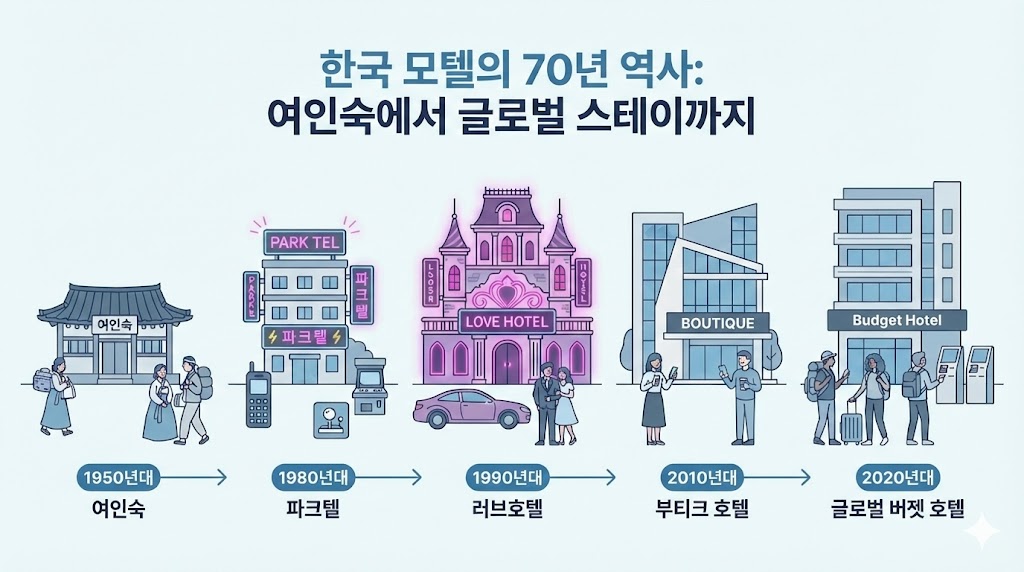
- Korean motels have reinvented themselves four times over 70 years: industrialization-era inns, pre-'88-Olympics "parktels," post-Olympics love hotels, and platform-era boutique hotels. Each shift was triggered by external forces.
- 2025 set a record with 18.94 million inbound visitors, marking the fifth inflection point. Yet motels — half the market — have barely tapped into this wave.
Most Koreans hear "motel" and picture neon signs, spinning beds, couples. I was no different until I made this industry my career.
The data tells a different story. According to Robin Company's Korea's Lodging Market 2024, Korea has 59,619 lodging establishments, and 51.5% of bookable rooms sit in motels (legally classified as yeogwan)[1]. Not hotels, not pensions, not resorts — motels. They're half the market. Even recent Chuseok holiday bookings split hotels (38.6%) and motels (36.0%) almost evenly, with pensions (24.5%) trailing far behind[2]. These numbers are too large to ignore, and this enormous market wasn't built overnight.
I studied computer science and started out as a developer. Somehow I've spent 18 years in hospitality. I launched Hanin Tel, a New York Korean homestay booking platform, in 2008. At Yellow Travel Labs I ran Wooripension, Hottel, and Jari. I founded ONDA in 2016 and have watched this industry evolve from the ground up ever since.
They say mountains and rivers change in ten years. Just as guests moved from walk-ins to smartphone bookings, motels have adapted to each era — even when they seemed stuck behind the same flashy banners. Now the fifth evolution has arrived.
First Generation: The Inn Era (1950s–70s)
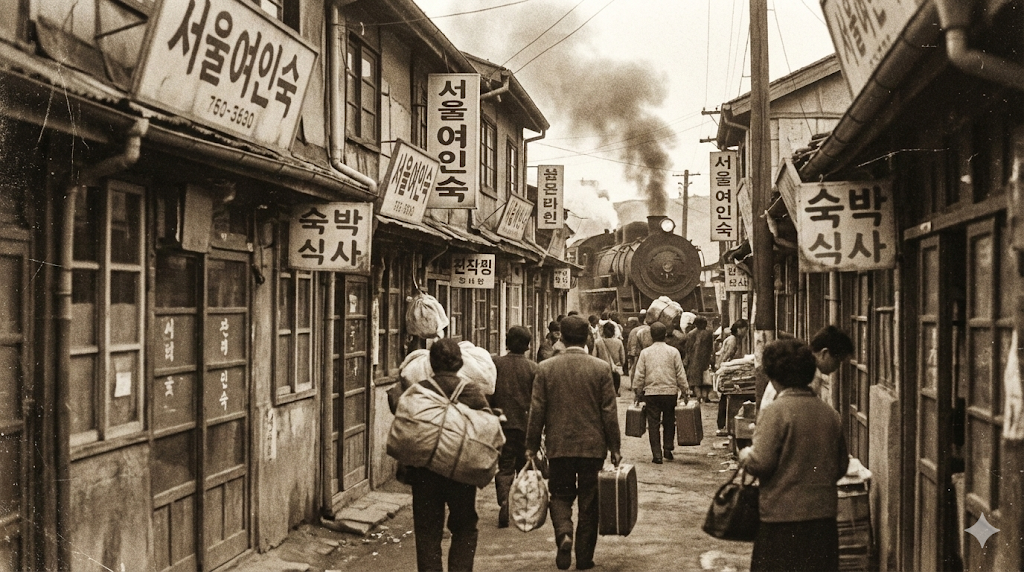
After the war, Korea industrialized. Young people left farms for factory jobs in the cities. They needed a place to sleep.
Inns and yeogwan sprang up near train stations and bus terminals. Through the 1970s, most rooms were 2–3 pyeong (about 70–100 sq ft), with shared toilets and showers[3]. An ondol room and a set of bedding — that was it.
Lodging served one purpose: sleep. Leisure was a luxury no one could afford. A salesman on a business trip, a young man in town for an interview, a parent visiting family in the city — the yeogwan was where they endured the night.
In August 1961, the government passed the Tourism Promotion Act to "boost foreign exchange earnings," carving out tourist hotels as a separate category[4]. That December it promulgated the Lodging Business Act (Act No. 809), effective January 1, 1962[5]. The new law divided lodging into hotel operations, yeogwan operations, inn (yeoinsuk) operations, and boarding-house operations. The word "motel" appeared nowhere. This classification persisted until 1999, when the Public Health Act was repealed and the Public Health Control Act replaced it, merging all lodging types into one legal framework[6].
Second Generation: The '88 Olympics and the Birth of Parktels (1980s)
The 1988 Seoul Olympics sparked the first major overhaul. The government pushed lodging upgrades in anticipation of athletes, media, and tourists flooding in from around the world. Existing yeogwan-level hospitality wouldn't cut it.
In 1986, the government enacted the Act on Support for Tourism and Lodging Businesses in Preparation for the Olympic Games, offering priority low-interest loans from the Tourism Promotion Fund for facility construction and renovation[7]. Long-term, low-rate capital flooded in. Owners rushed to upgrade. Rooms grew to 3–5 pyeong. Shared bathrooms gave way to en suites. Air conditioning and TVs moved in[3]. Properties rebranded as "○○ Parktel"[8], and yeogwan started calling themselves motels (Motor + Hotel) around this time[9].
This wave began with policy. External pressure — specifically, a massive international event — reshaped the landscape. The pattern would repeat, in Korea and beyond.
Third Generation: The Emergence of Love Hotels (1990s)
The Olympics ended. A child who looked my age rolled a hoop in the opening ceremony. Korea won 12 gold medals and finished fourth overall — a record that still stands[10]. But the lodging boom didn't last. Foreign guests left. Domestic demand couldn't fill the rooms.
Owners needed new customers. Facilities were better, but occupancy was down. They found their answer: couples.
Day-use (daesil) became the norm. Turning a room two or three times a day meant some properties ran occupancy above 100%, with strong margins.
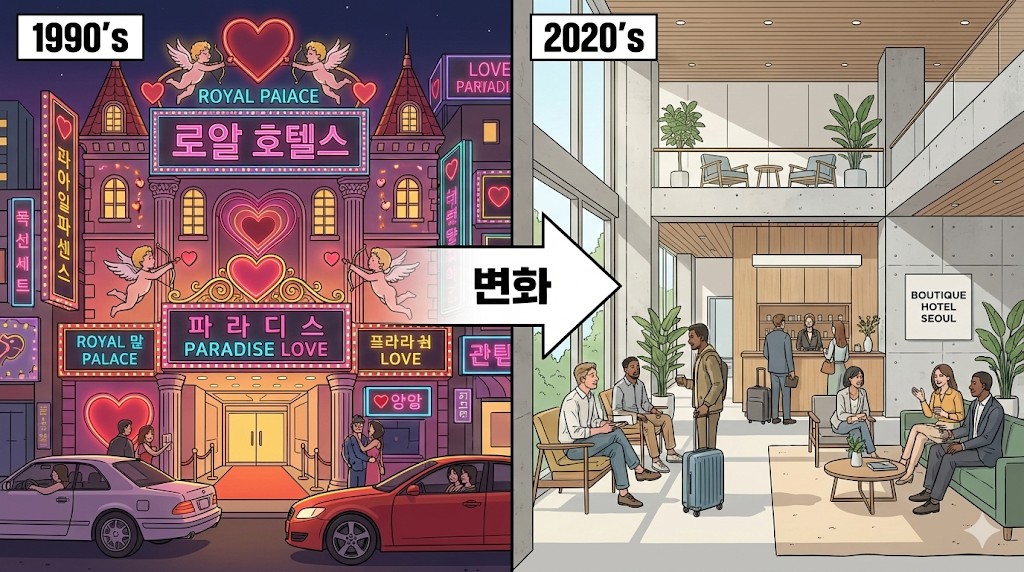
Love hotels appeared in entertainment districts and on city outskirts, equipped with spinning beds, mirrored ceilings, mood lighting. Motels became "that kind of place."
The old jang (莊) and yeogwan names vanished. "Motel" took over. But the term carried a new weight: seedy, illicit. Facilities and revenue improved. The image did not.
Fourth Generation: The Platform Era and the Boutique Hotel (2010s–)
The 2010s brought Yanolja and Yeogi Eottae. Smartphone booking arrived.
Competition for guests moved from roadside banners and restaurant partnerships to online forums, then to premium slots on booking platforms. Platforms made price comparison effortless. Owners fought for top placement with appealing photos, competitive rates, and strong reviews. The more popular the platform, the fiercer the race. Guests booked sight unseen, trusting photos and reviews.
Survival demanded better facilities. Motels poured money into interiors, photography, and platform ads. In 2011, Yanolja launched "Hotel Yaja," a motel franchise, followed by the smaller "Hotel Yam"[11]. These brands dropped "motel" for "boutique hotel." The pay-to-play structure — more ad spend, higher placement, more exposure — became entrenched.
The customer base broadened. Not just couples, but business travelers, families, solo guests looking for a break. Motels reinvented themselves again.
But new changes bring new problems. Demand stayed flat while platform power grew. Competition intensified, driving up ad spend. Platform dependence soared. Industry estimates put 80%+ of small-to-midsize motel revenue on two apps[12]. Price wars kept rates down while ad costs and commissions climbed. Interest rates, minimum wage, inflation — all rising. Occupancy — falling. Operators who invested tens of millions can't cover the interest. The structural trap is explored further in Why Motel Owners Are Struggling.
And Now: The Fifth Evolution
Inns became parktels. Love hotels became boutique hotels. Each time, motels adapted to the era's demands. Just as the '88 Olympics birthed parktels, external shifts have always driven evolution.
| Era | Trigger | Shift |
|---|---|---|
| 1950s–70s | Industrialization, urbanization | Inn → yeogwan |
| 1980s | '88 Olympics | Yeogwan → parktel/motel |
| 1990s | Post-Olympics vacancy | Overnight → day-use focus |
| 2010s | Mobile platforms | Motel → boutique hotel |
| 2020s | 20-million-visitor inbound era | ? |
The Korea Tourism Organization reported 18.94 million foreign visitors in 2025 — a record[13]. Yanolja Research forecasts Korea will cross 20 million for the first time in 2026[14]. K-pop, K-drama, K-beauty have made Korea a must-visit destination worldwide. Motels face another inflection point.
Yet motels — half the lodging market — remain on the sidelines of this massive wave. Why, and what we should do about it, is the subject of the next piece.
Rediscovering the Motel Series
- Part 1: Korean Motels at 70: The Fifth Evolution (this piece)
- Part 2: Why Motel Owners Are Struggling
- Part 3: Welcoming International Guests to Motels
References
- Robin Company, "Korea's Lodging Market 2024: Nationwide" (2025.4.15) · lobin.co
- NewDaily, "SOCAR: Gangwon-do tops Chuseok holiday destinations" (2024.9.13) · biz.newdaily.co.kr
- Global Economic (op-ed by Ji Jeong-seok), "[Op-ed] The evolution of lodging…from inns to motels, a complete transformation" (2016.11.9) · g-enews.com
- National Law Information Center, "Tourism Promotion Act [Act No. 689, Aug. 22, 1961, enacted]" · law.go.kr
- National Law Information Center, "Lodging Business Act [Act No. 809, Dec. 6, 1961, enacted]" · law.go.kr
- National Law Information Center, "Public Health Control Act [Act No. 5839, Feb. 8, 1999, enacted]" · law.go.kr
- National Law Information Center, "Act on Support for Tourism and Lodging Businesses in Preparation for the Olympic Games [Act No. 3844, May 12, 1986, enacted]" · law.go.kr
- Kyunghyang Weekly, "[Special] There's no place like a motel" (2005.8.9) · weekly.khan.co.kr
- Hankook Ilbo, "[Leisure] The history of 'motel,' a portmanteau of automobile and hotel" (2017.7.19) · hankookilbo.com
- Newsis, "[Sports Know-it-all] A history of Olympic challenges marked by adversity and emotion…who was the first medalist?" (2021.4.27) · newsis.com
- Dailian, "Yanolja surpasses 100 offline locations…aiming to shed 'love motel' image" (2016.8.2) · dailian.co.kr
- Korea Post, "Yanolja and Yeogi Eottae face renewed backlash over ad fees and commission abuse" (2025.10.13) · koreapost.co.kr
- Korea Tourism Organization, "December 2025 Korea Tourism Statistics Announcement" (2026.1.30) · datalab.visitkorea.or.kr
- Yanolja Research, "Vol.35 Forecasting Korea's Inbound and Outbound Tourism Demand for 2026" (2026.1.13) · yanolja-research.com
Frequently Asked Questions
- How many motels are there in Korea?
- According to Robin Company data, there were 59,619 lodging establishments nationwide in 2024, and motels account for 51.5% of available rooms. They are the largest segment occupying half of Korea's accommodation market, yet are often excluded from market discussions due to prejudice.
- How did motels evolve into their current form?
- They went through four generations. First, the yeogwan and yeoinsuks of the 1950s–70s industrialization period. Second, the parktels of the 1980s, when the government provided loans for facility upgrades ahead of the 88 Olympics. Third, the love hotels of the 1990s that shifted to day-use after the Olympics. And fourth, the boutique motels of the 2010s platform era. Each transition was triggered by external changes in the environment at the time.
- What is the fifth evolution?
- It is the shift from a structure that relied on domestic demand centered on day-use to one that accommodates foreign tourists. Foreign visitors to Korea reached an all-time high of 18.94 million in 2025, but motels — which represent half the accommodation market — have not yet connected with that demand, and that is the central concern of this series.